Today on Make-believe Mondays I'd like to introduce Kate Duggan, another of my RWAonline friends. Kate writes erotic romance as Kate Pearce.
Kate, first, tell us a little bit about the manuscript you’re working on now.
Kate: Well, first off my new e-book, Planet Mail a futuristic erotic romance comes out from Ellora’s Cave on July 5th!
I’m currently working on three others. The first is a proposal for my next Virgin Cheek book-three chapters and a synopsis. At the moment I’m stuck waiting for some feedback about sports injuries and rehab which will dictate the pace and time scale of the whole story.
I’m editing a companion book to my Ellora’s Cave ebook, “Eden’s Pleasure” which is about the second of the Harcourt twins. It’s due to my editor by the end of June.
The third is a new gothic erotic paranormal set in Georgian England which I am having a blast writing, probably because no one has contracted it.
Mark Twain said, “You cannot depend on your eyes when your imagination is out of focus.” How do you fill your creative well to keep your imagination in focus?
Kate: It’s hard. I tend to have a very tight focus on my writing and being productive and successful. I have to remember to get out and sniff the flowers, ride my horse, play with my 4 year old daughter and forget to stare at a computer screen. If I don’t, I can’t write.
Debra: It is a balance of sorts isn't it? Too much writing or too much play will tip that balance. I imagine that with a four year old the pull to write and the pull to your daughter could be equally as strong at times.
Is there a point when your characters begin to come alive and you can see and hear them?
Kate: Absolutely. I keep a page from one of the drafts of a Regency historical I wrote when the couple were supposed to indulge in some steamy lovemaking. I’m trying to type what I think should happen and somehow my fingers get taken over by them having a row. In caps I have typed WHAT ARE YOU TWO DOING??? They carried on arguing for days in my head before I finally gave in and let them have their way.
Debra: When characters come alive they can be very strong willed. It is after all their story.
Some very famous authors have played with language, creating words for people or places that no one has ever heard of. Have you ever played with words in that way and if so how?
Kate: I experimented with a couple of made up words and creatures in my new book Planet Mail which is set on another planet in the future. It was quite liberating!
Debra: Oh, what fun! Creatures! Now I'm intrigued. Just 9 more days until the book is out!
For some writers, dreams play a role in creating fiction. Has this been true for you? Have you ever dreamed a scene or an image that later wound up in one of your books?
Kate: All the time. The moments between waking and sleeping seem to produce some of my best ideas and scenes-it’s as if a piece of my subconscious peaks outs just in time to give me a visual, a scent or the answer to a plot question that has been plaguing me.
As a child did any particular book or author pull you into their imaginary world?
Kate: I loved a British historical writer called Rosemary Sutcliff. She wrote bitter-sweet children’s books about many different historical periods and her research was immaculate. One of her books about the Romans in Britain gave me the germ of the idea for the first book I ever wrote.
If there were no categories for books, no reader expectations to meet, and you could create the wildest work of imagination that you could think of what kind of story would that be?
Kate: I’m lucky enough to work with a publisher who already allows me to write that kind of story. My first published book was an erotic Regency romance but my editor didn’t turn a hair when I next presented her with a racy romp about intergalactic Vikings set in the future.
Is there anything else you would like to add about the role of imagination, and dreams in creating fiction? Any other message for our readers?
Kate: I think you have to push the envelope and let yourself explore emotions and places in your writing where you never thought you could go. We all have unique experiences and insights so use them to enhance and develop your voice.
Kate, thank you for joining us here on this Make-believe Monday to share a little bit of the magic of writing with our readers.
Kate: You are welcome!
Visit Kate at www.katepearce.com
Monday, June 26, 2006


Monday, June 19, 2006
Make-Believe Mondays With Celia May Hart

Today on Make-Believe Mondays I'd like to introduce Celia May Hart. Celia writes historical sensual romance set in the regency period (1800 to 1830) and her first book SHOW ME just came out from Kensingtons new erotic line, Aphrodisia.
Celia, first, tell us a little bit about the manuscript you're working on now.
Celia: I’m working on another Aphrodisia book, also a Regency-set historical, but this one has everything in it but the kitchen sink. (I almost gave it the title of “KITCHEN SINK” because I never get to keep titles anyway. Ok, I have once, so far.) It has time travel, adventure, paranormal elements in the form of Greek mythology coming to life.... And it’s just going to be a crazy, bantering, sexy yarn. If I finish it on time (I’ve just started it), it should be out in Summer 2007.
Debra: If I ever see a book titled KITCHEN SINK I'll think of you. It sounds like your work in progress will be great fun to write! And to read.
For some writers, dreams play a role in creating fiction. Has this been true for you? Have you ever dreamed a scene or an image that later wound up in one of your books?
Celia: Absolutely! I rely heavily on dreams or in that state just before you fall completely asleep to help me get through a book. I set myself what I think the characters need to do next, and then hopefully in the morning, I have some new pages to write. There is a scene in my upcoming novella in THE HAREM that was completely taken from a dream. I’m not going to include any spoilers, but there’s a fountain involved. Everything: the character emotions, the sound of the water, the colors, came in that dream and I think I managed to get it all down.
Debra: Oh, that's wonderful! So in a way the readers will be able to enter your dream with you.
If there were no categories for books, no reader expectations to meet, and you could create the wildest work of imagination that you could think of what kind of story would that be?
Celia: Um, I think I’m writing that book right now. There are so many “different” category elements in it, that it just might fit that bill. The wildest works of imagination usually find themselves in fantasy or literary fiction, for what it’s worth. *smile*
Is there anything else you would like to add about the role of imagination, and dreams in creating fiction? Any other message for our readers?
Celia: I’ve written stories for as long as I can remember, so the imagination has always been there. Sometimes, I think I’m not imaginative enough. For example, when the hero of my current work informs me (through the story) that the family has a legend, but that granny had garbled it into a riddle. So now I have to think of a riddle. Thanks a lot, Myles.
Debra: It's a bit like talking to the Cheshire cat, then isn't it? What fun!
Celia, thank you for joining us here on Make-Believe Mondays to share a bit of the magic of creating fiction with our readers.
Celia: Thanks Debra, for these questions. They were fun!
You can visit Celia at www.celiamayhart.com
Celia, first, tell us a little bit about the manuscript you're working on now.
Celia: I’m working on another Aphrodisia book, also a Regency-set historical, but this one has everything in it but the kitchen sink. (I almost gave it the title of “KITCHEN SINK” because I never get to keep titles anyway. Ok, I have once, so far.) It has time travel, adventure, paranormal elements in the form of Greek mythology coming to life.... And it’s just going to be a crazy, bantering, sexy yarn. If I finish it on time (I’ve just started it), it should be out in Summer 2007.
Debra: If I ever see a book titled KITCHEN SINK I'll think of you. It sounds like your work in progress will be great fun to write! And to read.
For some writers, dreams play a role in creating fiction. Has this been true for you? Have you ever dreamed a scene or an image that later wound up in one of your books?
Celia: Absolutely! I rely heavily on dreams or in that state just before you fall completely asleep to help me get through a book. I set myself what I think the characters need to do next, and then hopefully in the morning, I have some new pages to write. There is a scene in my upcoming novella in THE HAREM that was completely taken from a dream. I’m not going to include any spoilers, but there’s a fountain involved. Everything: the character emotions, the sound of the water, the colors, came in that dream and I think I managed to get it all down.
Debra: Oh, that's wonderful! So in a way the readers will be able to enter your dream with you.
If there were no categories for books, no reader expectations to meet, and you could create the wildest work of imagination that you could think of what kind of story would that be?
Celia: Um, I think I’m writing that book right now. There are so many “different” category elements in it, that it just might fit that bill. The wildest works of imagination usually find themselves in fantasy or literary fiction, for what it’s worth. *smile*
Is there anything else you would like to add about the role of imagination, and dreams in creating fiction? Any other message for our readers?
Celia: I’ve written stories for as long as I can remember, so the imagination has always been there. Sometimes, I think I’m not imaginative enough. For example, when the hero of my current work informs me (through the story) that the family has a legend, but that granny had garbled it into a riddle. So now I have to think of a riddle. Thanks a lot, Myles.
Debra: It's a bit like talking to the Cheshire cat, then isn't it? What fun!
Celia, thank you for joining us here on Make-Believe Mondays to share a bit of the magic of creating fiction with our readers.
Celia: Thanks Debra, for these questions. They were fun!
You can visit Celia at www.celiamayhart.com
Monday, June 12, 2006
Make-Believe Mondays With Ann Macela
This morning on Make-believe Mondays, I'm pleased to introduce Ann Macela, (Fredericka Meiners) one of my RWAonline friends. Ann writes paranormal romance for Medallion Press.
First, tell us a little bit about the manuscript you’re working on now.
Ann: Right now I’m working on “Magic3.” Magic1 is The Oldest Kind Of Magic, which was published in October 2005. Medallion Press, my publisher, is looking at Magic2, tentatively titled “Do You Believe In Magic?” Magic3 has no title yet—I haven’t come up with its “true name” yet. Magic1 was the story of Daria Morgan. Magic2 is her brother Clay’s story. Magic3 completes the trilogy with sister Gloriana.
Mark Twain said, “You cannot depend on your eyes when your imagination is out of focus.” How do you fill your creative well to keep your imagination in focus?
Ann: I read, especially mysteries and sci-fi/fantasy. I also tell myself stories before I fall asleep each night. These stories have nothing or little to do with my WIP. I have done this since I was a small child. When my mind is thinking about another story, ideas about the WIP just seem to come. I used this technique to work out a number of the aspects of my magic system.
Debra: What a fascinating way to put yourself to sleep! And it sure beats counting sheep.
Is there a point when your characters begin to come alive and you can see and hear them?
Ann: I think they’re alive from the first for me. However, I don’t know all about them. I’m a pantser for the most part, so I don’t do elaborate character sheets and outlines to begin with. So writing the story is an investigation into the H/H’s characters. I just realized an aspect of my hero’s character the other day, for example. Never would have thought it, but it really fits. Now to go back and make sure that aspect is “seeded” throughout the ms.
Debra: Most seat of the pants writers (including myself) enjoy those little surprises the characters can toss us even though it means rewriting. It's like getting to know a new friend.
Some very famous authors have played with language, creating words for people or places that no one has ever heard of. Have you ever played with words in that way and if so how?
Ann: Although I write paranormals and read lots of it and fantasy/sci-fi, I have not done this. I have created people and places, but I’m using plain old English to describe and explain my “magic practitioners” and their magic. If my story location was on another planet, then I might make up words—I’m thinking of the Darkover series as examples, but there are many others.
For some writers, dreams play a role in creating fiction. Has this been true for you? Have you ever dreamed a scene or an image that later wound up in one of your books?
Ann: I pay attention to my dreams, as I have found they tell me how I’m feeling—when everything’s going well, I fly in my dreams, like Superman. I haven’t consciously used any of my dreams in my stories, though. I do know there have been times when I wish I could have remembered what I was dreaming, because I woke up with the feeling of having a complete story in my head, but then, poof!, it was gone.
Debra: What a great dream to be flying! But oh, how sad to feel you had lost a story. I hope you can discover a way to keep them long enough to write them down.
As a child did any particular book or author pull you into their imaginary world?
Ann: What I remember most is reading Sherlock Holmes and other mysteries. I don’t remember any particular book. What I do remember is being a voracious reader who was always riding my bike to the library.
Debra: Those wonderful days of summer once school was out and you could read whatever you wanted, loading up that library card to the limit. Ah.....
If there were no categories for books, no reader expectations to meet, and you could create the wildest work of imagination that you could think of what kind of story would that be?
Ann: Probably what I’m writing now—lots of magic and hot sex! I do have a couple of ideas for stories set on another planet, but first I want to explore all the manifestations of my magic practitioners and the soulmate imperative.
Is there anything else you would like to add about the role of imagination, and dreams in creating fiction? Any other message for our readers?
Ann: Ask yourself, “What if . . . ?” and go from there. Nothing is too fanciful, too outrageous, too complicated. In fact, I prefer complication, not only in my plot, but also in the “world” of the book. When I first had the idea for Magic1, I had no idea the world of my magic practitioners would grow so complicated, so rich in detail and organization. I finally had to write it all down—see “A Theory of Magic” on my website.
Also, pay attention to your dreams. You may get a story out of them, you may not, but they will tell you how you are.
Debra: Excellent advice. Thank you for joining us here on this Make-believe Monday to share a little bit of the magic of writing with our readers.
Ann: Thanks, it’s been fun.
Visit Ann at http://www.annmacela.com
First, tell us a little bit about the manuscript you’re working on now.
Ann: Right now I’m working on “Magic3.” Magic1 is The Oldest Kind Of Magic, which was published in October 2005. Medallion Press, my publisher, is looking at Magic2, tentatively titled “Do You Believe In Magic?” Magic3 has no title yet—I haven’t come up with its “true name” yet. Magic1 was the story of Daria Morgan. Magic2 is her brother Clay’s story. Magic3 completes the trilogy with sister Gloriana.
Mark Twain said, “You cannot depend on your eyes when your imagination is out of focus.” How do you fill your creative well to keep your imagination in focus?
Ann: I read, especially mysteries and sci-fi/fantasy. I also tell myself stories before I fall asleep each night. These stories have nothing or little to do with my WIP. I have done this since I was a small child. When my mind is thinking about another story, ideas about the WIP just seem to come. I used this technique to work out a number of the aspects of my magic system.
Debra: What a fascinating way to put yourself to sleep! And it sure beats counting sheep.
Is there a point when your characters begin to come alive and you can see and hear them?
Ann: I think they’re alive from the first for me. However, I don’t know all about them. I’m a pantser for the most part, so I don’t do elaborate character sheets and outlines to begin with. So writing the story is an investigation into the H/H’s characters. I just realized an aspect of my hero’s character the other day, for example. Never would have thought it, but it really fits. Now to go back and make sure that aspect is “seeded” throughout the ms.
Debra: Most seat of the pants writers (including myself) enjoy those little surprises the characters can toss us even though it means rewriting. It's like getting to know a new friend.
Some very famous authors have played with language, creating words for people or places that no one has ever heard of. Have you ever played with words in that way and if so how?
Ann: Although I write paranormals and read lots of it and fantasy/sci-fi, I have not done this. I have created people and places, but I’m using plain old English to describe and explain my “magic practitioners” and their magic. If my story location was on another planet, then I might make up words—I’m thinking of the Darkover series as examples, but there are many others.
For some writers, dreams play a role in creating fiction. Has this been true for you? Have you ever dreamed a scene or an image that later wound up in one of your books?
Ann: I pay attention to my dreams, as I have found they tell me how I’m feeling—when everything’s going well, I fly in my dreams, like Superman. I haven’t consciously used any of my dreams in my stories, though. I do know there have been times when I wish I could have remembered what I was dreaming, because I woke up with the feeling of having a complete story in my head, but then, poof!, it was gone.
Debra: What a great dream to be flying! But oh, how sad to feel you had lost a story. I hope you can discover a way to keep them long enough to write them down.
As a child did any particular book or author pull you into their imaginary world?
Ann: What I remember most is reading Sherlock Holmes and other mysteries. I don’t remember any particular book. What I do remember is being a voracious reader who was always riding my bike to the library.
Debra: Those wonderful days of summer once school was out and you could read whatever you wanted, loading up that library card to the limit. Ah.....
If there were no categories for books, no reader expectations to meet, and you could create the wildest work of imagination that you could think of what kind of story would that be?
Ann: Probably what I’m writing now—lots of magic and hot sex! I do have a couple of ideas for stories set on another planet, but first I want to explore all the manifestations of my magic practitioners and the soulmate imperative.
Is there anything else you would like to add about the role of imagination, and dreams in creating fiction? Any other message for our readers?
Ann: Ask yourself, “What if . . . ?” and go from there. Nothing is too fanciful, too outrageous, too complicated. In fact, I prefer complication, not only in my plot, but also in the “world” of the book. When I first had the idea for Magic1, I had no idea the world of my magic practitioners would grow so complicated, so rich in detail and organization. I finally had to write it all down—see “A Theory of Magic” on my website.
Also, pay attention to your dreams. You may get a story out of them, you may not, but they will tell you how you are.
Debra: Excellent advice. Thank you for joining us here on this Make-believe Monday to share a little bit of the magic of writing with our readers.
Ann: Thanks, it’s been fun.
Visit Ann at http://www.annmacela.com
Monday, June 05, 2006
Make-Believe Mondays With Michele Ann Young

It gives me a great thrill on this Make-Believe Monday to introduce one of my American Title II sisters. Michele Ann Young is the first of our group to have sold a book, just months after finalling in the contest. Pistols At Dawn is a June 2006 release and I can't wait to read it.
Now let's chat with Michele.
First, tell us a little bit about the manuscript you’re working on now.
Michele: I am working on two novels at the moment. One is historical fiction, set in 1809 and my British heroine is deeply involved the war with Napoleon. It is probably what would be described as a bombshell. Because the story revolves around historical events, it requires a substantial amount of detailed research.
The other novel is a romance, set in Kent in the Regency, but it deals with a woman at risk, the same kinds of risks women face today. What interests me, is how women have always had the same issues to deal with and how different generations have handled them. Obviously, women had a lot less freedom in the 1800’s than we do today, but ssurprisingly many of them managed to take control of their lives, nevertheless.
Debra: Women have strengths they often don't realize until put to the test. This is one of the wonderful things about historical fiction. That theme of strong women.
Is there a point when your characters begin to come alive and you can see and hear them?
Michele: It always starts with a character in one scene and moves from there. My characters come alive to me the minute they walk on stage. Translating the vision into words that create the same or similar picture for the reader is the challenge. I do find that my characters don’t fully develop for me until most of the story is done. Quite often I learn things about them at the end, that I did not know at the beginning. This can be wonderful and amazing but it usually means a lot of revisions.
Debra: So you get to know your characters as you go along. I've met many writers who find that to be true for them as well.
Some very famous authors have played with language, creating words for people or places that no one has ever heard of. Have you ever played with words in that way and if so how?
Michele: I have been working on a fantasy, more for fun than as a serious work. It is a world with its own culture and names for things, and creatures that do not exist in our world. It has it’s own set of rules and some magical elements. It’s lots of fun, and I keep a glossary or dictionary as I go along. I also have a map to keep track of locations of continents and oceans. For each word or name I write a brief definition and sometimes a description, particularly if it is an animal or a race of people, that way I have it fixed in my head. It is a quest story so it has lots of adventure, but there is a strong romantic element. I usually write it when I am at the beach and my imagination is free to wander without interruption..
Debra: What fun! And isn't it lovely to be able to write at the beach!
Michele, thank you for joining us here on this Make-believe Monday to share a little bit of the magic of writing with our readers.
Visit Michele at http://www.micheleannyoung.com/

Monday, May 15, 2006
Make-Believe Mondays With Jan Conwell
Today on Make-believe Mondays I'm happy to introduce Jan Conwell, my friend from RWAonline. Jan and I share a love of the medieval through our involvement in the SCA, a group which recreates the middle ages. Jan writes contemporary romance and romantic suspense and has her first book coming out soon.
Jan, tell us a little bit about the manuscript you’re working on now.
Jan: I just finished a romantic suspense, (possibly the first in a series of three) called Tequila Mockingbird. But this month (drumroll? Pretty please?) my first book, a contemporary romance called Lucky Break, comes out with Triskelion Publishing, first in electronic format and then in print through Amazon. It’s about a flighty neo-hippy who ends up with a job teaching Aircraft Fuel Systems for the Air Force (it can happen, I promise) and the poor sap who gets stuck trying to train her.
Debra: Excellent news Jan. And worthy of more than just a drum roll.
Is there a point when your characters begin to come alive and you can see and hear them?
Jan: Yes, but since I’ve only completed two books so far, I don’t have much experience with this. With Tequila Mockingbird, I discovered about halfway in that my heroine was very much like Janeane Garofalo—short, dark, dumpy in a tall blonde skinny world, and highly pissed about it. It took her a long time to let herself believe Gabe could love her just the way she was.
Some very famous authors have played with language, creating words for people or places that no one has ever heard of. Have you ever played with words in that way and if so how?
Jan: LOL! Yes. One of my favorite authors is Tom Robbins. He writes with this insane sort of excess, like an artist who just throws tons of bright paint on the canvas, but he does it with a voice that is identifiable to anyone who’s ever read him. I tried to imitate that reckless excess in a scene in Lucky Break. Everyone who read it said “Um, this bit…it’s just too…much.” So it’s true what they say: you must kill your darlings. I had to cut that part out. But one of these days, I’m going to try it again, on a short story, something…because it’s like learning a new art medium.
Debra: Experimenting like this is a great way to grow as an author. I like the idea of feeling free enough in your craft to throw the words out like paint on a canvas then stepping back to see what you have.
As a child did any particular book or author pull you into their imaginary world?
Jan: Without doubt, Dr. Seuss. The way he could be silly and serious at the same time, not to mention the fun drawings of bizarre plants and creatures, loved that. It was like having permission to be ridiculous.
Debra: Yes, I loved Dr. Seuss also! And when I started reading his books to my children, I discovered he also wrote for adults. He was a genius who really knew how to play with language.
If there were no categories for books, no reader expectations to meet, and you could create the wildest work of imagination that you could think of what kind of story would that be?
Jan: I want to write fantasy one of these days—I know that’s a category, but it’s one I haven’t given myself permission to dabble in very deeply yet. First, and for a while after this, I’ll stick with contemporary romance, maybe with some paranormal or suspense. Reader expectation, branding, editor preference, call it what you will. But I have this medieval fantasy brewing, and it will not let me go. I call it Woldryn’s Star, and I’m in love with the characters. Someday, even if I have to use a pen name, I’m going to write this.
Debra: With your love of the medieval and the experience you've had playing at SCA events I'm sure you could bring a story like that to life! Sadly it is true that authors have to stick with one category for a while to meet reader expectation. I sometimes wonder if an author is prolific and writes many different things, how many names that author could write under.
Thank you Jan, for joining us here on this Make-believe Monday to share a little bit of the magic of writing with our readers.
Jan: Glad to be here. One of these days, readers, look for Debra Parmley’s interview on Starfish and Coffee: she's headed for big things!
You can visit Jan at www.janconwell.com or her blog, Starfish and Coffee at http://jbdconwell.livejournal.com where she interviews industry professionals.
Jan, tell us a little bit about the manuscript you’re working on now.
Jan: I just finished a romantic suspense, (possibly the first in a series of three) called Tequila Mockingbird. But this month (drumroll? Pretty please?) my first book, a contemporary romance called Lucky Break, comes out with Triskelion Publishing, first in electronic format and then in print through Amazon. It’s about a flighty neo-hippy who ends up with a job teaching Aircraft Fuel Systems for the Air Force (it can happen, I promise) and the poor sap who gets stuck trying to train her.
Debra: Excellent news Jan. And worthy of more than just a drum roll.
Is there a point when your characters begin to come alive and you can see and hear them?
Jan: Yes, but since I’ve only completed two books so far, I don’t have much experience with this. With Tequila Mockingbird, I discovered about halfway in that my heroine was very much like Janeane Garofalo—short, dark, dumpy in a tall blonde skinny world, and highly pissed about it. It took her a long time to let herself believe Gabe could love her just the way she was.
Some very famous authors have played with language, creating words for people or places that no one has ever heard of. Have you ever played with words in that way and if so how?
Jan: LOL! Yes. One of my favorite authors is Tom Robbins. He writes with this insane sort of excess, like an artist who just throws tons of bright paint on the canvas, but he does it with a voice that is identifiable to anyone who’s ever read him. I tried to imitate that reckless excess in a scene in Lucky Break. Everyone who read it said “Um, this bit…it’s just too…much.” So it’s true what they say: you must kill your darlings. I had to cut that part out. But one of these days, I’m going to try it again, on a short story, something…because it’s like learning a new art medium.
Debra: Experimenting like this is a great way to grow as an author. I like the idea of feeling free enough in your craft to throw the words out like paint on a canvas then stepping back to see what you have.
As a child did any particular book or author pull you into their imaginary world?
Jan: Without doubt, Dr. Seuss. The way he could be silly and serious at the same time, not to mention the fun drawings of bizarre plants and creatures, loved that. It was like having permission to be ridiculous.
Debra: Yes, I loved Dr. Seuss also! And when I started reading his books to my children, I discovered he also wrote for adults. He was a genius who really knew how to play with language.
If there were no categories for books, no reader expectations to meet, and you could create the wildest work of imagination that you could think of what kind of story would that be?
Jan: I want to write fantasy one of these days—I know that’s a category, but it’s one I haven’t given myself permission to dabble in very deeply yet. First, and for a while after this, I’ll stick with contemporary romance, maybe with some paranormal or suspense. Reader expectation, branding, editor preference, call it what you will. But I have this medieval fantasy brewing, and it will not let me go. I call it Woldryn’s Star, and I’m in love with the characters. Someday, even if I have to use a pen name, I’m going to write this.
Debra: With your love of the medieval and the experience you've had playing at SCA events I'm sure you could bring a story like that to life! Sadly it is true that authors have to stick with one category for a while to meet reader expectation. I sometimes wonder if an author is prolific and writes many different things, how many names that author could write under.
Thank you Jan, for joining us here on this Make-believe Monday to share a little bit of the magic of writing with our readers.
Jan: Glad to be here. One of these days, readers, look for Debra Parmley’s interview on Starfish and Coffee: she's headed for big things!
You can visit Jan at www.janconwell.com or her blog, Starfish and Coffee at http://jbdconwell.livejournal.com where she interviews industry professionals.
Monday, May 08, 2006
Make-Believe Mondays With Claire Delacroix
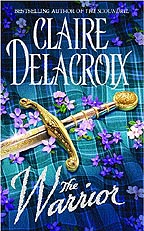
Today on Make-believe Mondays I'm pleased to introduce Claire Delacroix my friend from RWAonline. Claire writes historical medieval romance as Claire Delacroix and she also writes contemporary romance under the name Claire Cross.
Claire, first, tell us a little bit about the manuscript you’re working on now.
Claire: Right now, I'm writing ALL OR NOTHING, the fourth and final book in the Coxwell siblings series, a Claire Cross contemporary romance for Berkley Sensation.
(The earlier titles were THIRD TIME LUCKY, starring Philippa Coxwell;
DOUBLE TROUBLE, James Coxwell's story; and ONE MORE TIME, Matt Coxwell's book, which will be out in October.) The hero is Zach Coxwell, the youngest son and resident troublemaker. He's funny, which makes him entertaining to write about, even if he is a bit of a challenge. (Unpredictable, impulsive, reliant upon his considerable charm - you know the type.) The heroine, Jennifer, thinks he's a rich kid who doesn't take anything seriously, but is enchanted by him all the same - mostly because he keeps surprising her. I'm enjoying it: the two strike sparks off each other every time I put them together and they push each other, which I like a lot.
Debra: This sounds like a fun read. I can't wait!
Mark Twain said, “You cannot depend on your eyes when your imagination is out of focus.” How do you fill your creative well to keep your imagination in focus?
Claire: It sounds as if you have also read Julia Cameron's THE ARTISTS' WAY - I think the well metaphor is hers. She has a lot of good advice, mostly about being kind to your inner artist so that you can continue to create. I've found her book to be very useful and still do my morning pages.
Debra: Yes, it may be one of hers. Actually you were the one who recommended it to me about a year ago. Thank you Claire. I found it to be very uplifting. Its the kind of book I can return to and always get something more out of it.
Claire: It's important to remember that writing books is not the same as producing widgets - it requires more energy and more mental stimulation. So, over the years, I've gotten better at being kind to myself and have struck a balance: I work a limited number of hours per day and deliberately spend time doing things that I know my inner artist likes - mostly pursuing color. I go to art galleries and museums, visit gardens, prowl through knitting wool and quilting stores. I knit and quilt and garden myself, all of which are activities with a repetitive routine. This kind of repetition lets stories take shape in my mind while I'm not paying attention - much like dreaming. My subconscious gets bored and wanders off to find something else to do.
Like fix my plot. Bingo! I'll be up to my knees in uprooted periwinkle and suddenly know exactly what comes next. It's like magic.
Debra: I can just picture you in your garden amid the periwinkle, daydreaming a new story.
Is there a point when your characters begin to come alive and you can see and hear them?
Claire: Sometime in the first 100 pages of a manuscript, I'll start to hear the characters talking. This is usually when they seize the plot and run in a different direction than the one I'd anticipated.
Debra: Oh, don't you just love it when that happens?
Claire: I tend to think of my imagination as a rental apartment: with each new book, I choose the new tenants, then give them time to settle in and arrange their things. When they start talking to each other, I start eavesdropping, like a nosy landlady, and that's when the book comes to life. They get evicted when the book is done, but not all of them depart quietly. Those ones come back for cameo appearances in subsequent books.
Or they just haunt me, as Darg and Isabella are doing now. Too bad the fairy Darg doesn't know enough about sex (or anything, really) to satisfy Isabella's curiosity. Then they could solve everything without me.
Debra: Darg is such a fun and unpredictable character. She would likely solve things in a very unexpected way!
Some very famous authors have played with language, creating words for people or places that no one has ever heard of. Have you ever played with words in that way and if so how?
Claire: Well, I've made up fictional locations for my historicals, but probably everybody does that.
I've also just finished the first book in a mystery series set in the future, and that was an interesting challenge with language. In this fictional world, there was technology that we don't have (yet) which needed to be named. I didn't want there to be a language barrier, so I nudged words that already exist toward new meanings. I think that people are more likely to adapt existing words to name new technology and ideas, at least colloquially. That makes my fictional world both familiar and not, which was a lot of fun.
Debra: Fascinating. I like the idea of finding new meanings for words we already know. So you're trying something quite new!
Claire: (Keep your fingers crossed for Lilia's story, please - it's in New York, even as we speak.)
Debra: Oh yes, I'll cross fingers and toes.
For some writers, dreams play a role in creating fiction. Has this been true for you? Have you ever dreamed a scene or an image that later wound up in one of your books?
Claire: Actually, I use dreaming as a writing technique. I tend to paint my characters into corners (metaphorically speaking) and whenever I can't figure out the answer, I try to dream it. This isn't as nutty as it sounds - the subconscious is really good at solving problems. Before going to sleep, I focus on the issue in the book and review all the facets of it that I can recall. It's quite common that I awaken in the morning with the answer in my head, either the dialogue of the new scene running or a dream still in my mind's eye providing the answer. I've seen other authors give credit to this technique, too, which is reassuring as it sounds a bit crazy.
Debra: I've always suspected dreams play a larger role in the creation of fiction than most people realize. It's definitely something to try.
If there were no categories for books, no reader expectations to meet, and you could create the wildest work of imagination that you could think of what kind of story would that be?
Claire: Well, some people might argue that I don't think enough about the market! I tend to follow my characters and my muse, and don't worry about marketing when I'm excited about a story. When I do think a lot about the romance market, I come to different conclusions about it than everyone else. For example, I believe that the genre has suffered in the last decade from too much determination - on the part of both editors and writers - to make books "safe". There's a uniformity in the genre that wasn't there even ten years ago, and especially not twenty years ago. And I think that this insistence upon alpha heroes and feisty heroines, for example, on protagonists that are always sympathetic has disappointed a number of readers. Do all historicals have to be set in Scotland? Why can't we have a real character arc, and show a protagonist being changed by the power of love? Readers who savor diversity and unpredictability in their fiction - according to my theory, at least - have left the romance section, which is why romance genre sales are dropping.
Debra: Claire, it is so good to hear you say this. I think writers need to hear this and they need to be willing to be a bit more daring with their fiction so that we have more diversity and more choices as readers.
Claire: For this reason and for the creative challenge, I decided about five years ago to write romances that pushed the boundaries of expectations. I thought, actually, that the romance market was ready for some fresh thinking. For Claire Delacroix these included:

• THE ROGUE, an historical romance written in first person from the heroine's point of view in which she's uncertain of the hero's motives, like those Gothics we used to love;

• THE SCOUNDREL, an historical romance written in first person, half of the book from the hero's point of view and half from the heroine's, in which the hero who is the eponymous scoundrel is reformed by love;
• THE WARRIOR, an historical romance with a reincarnation element to the story, in which the heroine has dreams, the hero has visions of their past together and they both think they're losing their jellybeans.
Claire Cross, of course, has the Coxwell family series, which also defy conventions of the romance genre with their ChickLit tone and exploration of taboos.

• ONE MORE TIME (October 2006) is about a married couple, Matt and Leslie, who split up at the beginning of the book. Even worse, Matt goes to stay with an old girlfriend, but Leslie still wants to save their marriage.
 • In ALL OR NOTHING, Zach has a history of encounters with law enforcement officials. Does that mean he can't grow up and become an adult, fall in love and make something of himself? I think that loving Jen can prompt him to do so, and I'm going to prove it!
These books are about real characters, not about fantasized archetypes, and I think that makes them more compelling and more interesting. All of these stories are about love redeeming characters, which is the fundamental premise of a romance but one that seems to have gotten lost in the shuffle. If we believe that love can and does conquer all, shouldn't we as writers give love a real challenge? It's not much of a triumph if love only conquers a misunderstanding!
Debra: Yes!
Claire: I believe that love really does reshape lives and I want to show its power at work in my books. I want to give it something to fix - because really, I'm only going to believe that the protagonists of a romance have built a relationship that can go the distance if I get to watch them face a very serious challenge.
• For example, Jen, the heroine in ALL OR NOTHING, is a breast cancer survivor. You will guess, then, that the root of her fear is that Zach will only hang around for the good times and that if she has a recurrence, he'll bail (like her last boyfriend did). So, guess what happens near the end of the book? Zach has to face that test, that twist has to happen, so that Jen and all of us know that he's the hero for her. It's not a lot of fun to put your characters through the wringer, but I need to know (and all readers need to know) that Jen and Zach really will be happy ever after.
I've never thought these books were that risky - and still don't - in fact, I think they're necessary. Writers are the creative party in the publishing triumvirate (agent, editor, author) and it's our responsibility to find new stories to tell and new ways of telling them.
Debra: Yes!
Claire: I do know that these have been the most satisfying books creatively that I've ever written: they challenged me and are my best work to date. Isn't that why we're writers in the first place? To tell our stories in the most compelling way possible? That's certainly why I signed up for this dream job. Otherwise, we might as well all be delivering pizza.
Debra: It is a dream job, isn't it? Claire, thank you for joining us here on this Make-believe Monday to share a little bit of the magic of writing with our readers.
Claire: Thanks for inviting me, Debra. It's been fun.
Debra: I'm so glad!
You can visit Claire at http://www.delacroix.net
Monday, May 01, 2006
Make-Believe Mondays With Lori Devoti
Today on Make-believe Mondays I'm pleased to introduce Lori Devoti, one of my friends from RWAonline. Lori writes romantic comedy set in the Missouri Ozarks. If you enjoy comedy, you'll enjoy her latest book, Love is All Around.
Lori, first, tell us a little bit about the manuscript you’re working on now.
Lori: Well, I just finished a proposal for a dark paranormal totally different than either of my published books. I also have proposals out for a paranormal mom lit, a hen lit, and a couple romantic comedies. I’m researching a paranormal female adventure type story now.
Debra: Wow! you have been busy.
Mark Twain said, “You cannot depend on your eyes when your imagination is out of focus.” How do you fill your creative well to keep your imagination in focus?
Lori: A friend told me a shoot out ideas like gumballs out of a vending machine. I thought that was funny. And while I prefer it to struggling for ideas, it can be difficult to. You can begin to feel a tad haunted. Usually though, one idea somehow manages to bubble to the top.
Debra: Gumballs out of a vending machine. That's a good one.
Lori: I also have a book I keep working on in downtime. Meaning when I don’t have another driving idea. I go back to it to refill I guess. It’s nice to have something I feel I can just take my time with and enjoy writing or researching. I am very deadline driven so that is a real weakness of mine—feeling I need to be pounding something out all the time.
Is there a point when your characters begin to come alive and you can see and hear them?
Lori: My characters are always alive. What I do find sometimes though is that there are aspects that aren’t as focused as others, especially if it is a growth area for that character. For example in my dark paranormal, my heroine is a strong person, but doesn’t see herself that way. Thus the book starts with her seeing herself weak but will end with her being much stronger. It took a few passes to get that figured out in the beginning chapters.
As a child did any particular book or author pull you into their imaginary world?
Lori: I had a ton of favorite writers/books. I loved Zane Grey, the Anne of Green Gables series, Alexander Dumas, Black Like Me, and A Little Princess. I think I read A Little Princess twenty times. I still remember where it was shelved in our library. The same goes for the Zane Grey books—I went back over and over to get new ones, ordered them direct from the publisher and read old ones my mother had. LOVED them!
Debra: That's the true test of which stories children love. When they return to them again and again.
If there were no categories for books, no reader expectations to meet, and you could create the wildest work of imagination that you could think of what kind of story would that be?
Lori: Books with strong women, that could be funny, but didn’t have to be. So a mix of serious and funny—but definitely strong female characters, and maybe a pet. I have a weakness for pets. ;-)
Debra: Yes, your pet pig toadstool comes to mind. (Readers can see a picture of Lori with her pet pig by visiting her website at www.LoriDevoti.com) She also had a duck named Spud and a pony named Wishbone.
Lori, thanks for visiting here on Make-believe Mondays.
Lori, first, tell us a little bit about the manuscript you’re working on now.
Lori: Well, I just finished a proposal for a dark paranormal totally different than either of my published books. I also have proposals out for a paranormal mom lit, a hen lit, and a couple romantic comedies. I’m researching a paranormal female adventure type story now.
Debra: Wow! you have been busy.
Mark Twain said, “You cannot depend on your eyes when your imagination is out of focus.” How do you fill your creative well to keep your imagination in focus?
Lori: A friend told me a shoot out ideas like gumballs out of a vending machine. I thought that was funny. And while I prefer it to struggling for ideas, it can be difficult to. You can begin to feel a tad haunted. Usually though, one idea somehow manages to bubble to the top.
Debra: Gumballs out of a vending machine. That's a good one.
Lori: I also have a book I keep working on in downtime. Meaning when I don’t have another driving idea. I go back to it to refill I guess. It’s nice to have something I feel I can just take my time with and enjoy writing or researching. I am very deadline driven so that is a real weakness of mine—feeling I need to be pounding something out all the time.
Is there a point when your characters begin to come alive and you can see and hear them?
Lori: My characters are always alive. What I do find sometimes though is that there are aspects that aren’t as focused as others, especially if it is a growth area for that character. For example in my dark paranormal, my heroine is a strong person, but doesn’t see herself that way. Thus the book starts with her seeing herself weak but will end with her being much stronger. It took a few passes to get that figured out in the beginning chapters.
As a child did any particular book or author pull you into their imaginary world?
Lori: I had a ton of favorite writers/books. I loved Zane Grey, the Anne of Green Gables series, Alexander Dumas, Black Like Me, and A Little Princess. I think I read A Little Princess twenty times. I still remember where it was shelved in our library. The same goes for the Zane Grey books—I went back over and over to get new ones, ordered them direct from the publisher and read old ones my mother had. LOVED them!
Debra: That's the true test of which stories children love. When they return to them again and again.
If there were no categories for books, no reader expectations to meet, and you could create the wildest work of imagination that you could think of what kind of story would that be?
Lori: Books with strong women, that could be funny, but didn’t have to be. So a mix of serious and funny—but definitely strong female characters, and maybe a pet. I have a weakness for pets. ;-)
Debra: Yes, your pet pig toadstool comes to mind. (Readers can see a picture of Lori with her pet pig by visiting her website at www.LoriDevoti.com) She also had a duck named Spud and a pony named Wishbone.
Lori, thanks for visiting here on Make-believe Mondays.
Monday, April 10, 2006
Make-Believe Monday With Lois Winston

Today on Make-believe Mondays we have Lois Winston. Lois was first runner up in the American Title contest last year. It's such a thrill to see how the careers of last years finalists have taken off.
Lois, first, tell us a little bit about the manuscript you’re working on now.
Lois: Because my publisher is looking for romantic suspense, I’ve gone back to some of my older manuscripts (I started out writing r/s) and am rewriting them. I still believe in the stories and the characters I created and would love to see them published eventually. However, I cringed when I first reread them after so many years. I now see why they didn’t sell at the time and can also see how much I’ve matured as a writer. It’s actually a really good feeling.

Mark Twain said, “You cannot depend on your eyes when your imagination is out of focus.” How do you fill your creative well to keep your imagination in focus?
Lois: I get quite a bit of my inspiration from reading the newspaper, especially the human interest stories and the letters to Dear Abby. I keep a file of anything that interests me. When my muse takes a holiday and my imagination become uncooperative, I sit down with that file and start reading. Before I’ve gotten very far, the muse returns and my imagination stops putting up a fight.
Is there a point when your characters begin to come alive and you can see and hear them?
Lois: Oh yes! All the time. And sometimes at the most inopportune moments. I remember an episode of Bewitched years ago where Samantha is writing a play. The characters come alive in her living room and begin talking to her, helping her write the script. Sometimes I feel like that’s happening to me. It gets a bit awkward on occasion, though, especially when it happens in an aisle of the supermarket or during a doctor’s appointment!
Some very famous authors have played with language, creating words for people or places that no one has ever heard of. Have you ever played with words in that way and if so how?
Lois: I don’t make up words, but I love onomatopoeia. So I often play with phrasing. I also like to put a different spin on common phrases to make them fresh and a bit out of the ordinary. I also love to choose character names and settings for my stories that have a bit of double-entendre to them or a Dickensian nature. For instance, the father in Talk Gertie To Me is Earnest Stedworth. And he certainly is!
For some writers, dreams play a role in creating fiction. Has this been true for you? Have you ever dreamed a scene or an image that later wound up in one of your books?
Lois: You have no idea how apropos this question is for me! I began writing because of a recurring dream that kept growing. Each night another chapter played out. When the dream began taking over my daytime thoughts, I knew it was time to get it down on paper. That dream became my first manuscript. I also find that I often can’t fall asleep at night until I puzzle out the next scene in my current manuscript. If something is giving me problems, and I’ve written myself into a corner, I need to find a solution before I can shut down my brain and go to sleep at night.
As a child did any particular book or author pull you into their imaginary world?
Lois: In grammar school I devoured the Cherry Ames series. For several years I wanted to become a nurse because of the influence the books had on me. By junior high I had very eclectic taste. One summer I read The Hobbit and the complete Lord of the Rings trilogy, Gone with the Wind, Marjorie Morningstar, and Peyton Place (the last two on the sly.)
If there were no categories for books, no reader expectations to meet, and you could create the wildest work of imagination that you could think of what kind of story would that be?
 Lois: One that lands me on the NY Times best-seller list? Truthfully, this is a very difficult question to answer. I write in several genres and also write cross-genre. It really depends on the story that’s burning within me at any given moment. I write what I want to write. I don’t write to the market because the market is always changing. It’s far better to be a trend-setter than a trend-follower. I’m just hoping that one of these days one of my books does trigger a trend. After all, who wouldn’t want to be the next J.K. Rowling or Dan Brown?
Is there anything else you would like to add about the role of imagination, and dreams in creating fiction? Any other message for our readers?
Lois: The one thing I’d like to stress is that if you have a passion to write, don’t stop. Keep writing, no matter how many rejection letters you receive, no matter how many obstacles are thrown your way. I know it sounds cliché, but you won’t succeed at something if you allow defeatism to rule your life. It took me 10 years from the time I wrote down that dream until I sold my first book. Some dreams just take a bit longer than others to come true.
Lois, thank you for joining us here on this Make-believe Monday. Visit www.loiswinston.com
Lois, first, tell us a little bit about the manuscript you’re working on now.
Lois: Because my publisher is looking for romantic suspense, I’ve gone back to some of my older manuscripts (I started out writing r/s) and am rewriting them. I still believe in the stories and the characters I created and would love to see them published eventually. However, I cringed when I first reread them after so many years. I now see why they didn’t sell at the time and can also see how much I’ve matured as a writer. It’s actually a really good feeling.

Mark Twain said, “You cannot depend on your eyes when your imagination is out of focus.” How do you fill your creative well to keep your imagination in focus?
Lois: I get quite a bit of my inspiration from reading the newspaper, especially the human interest stories and the letters to Dear Abby. I keep a file of anything that interests me. When my muse takes a holiday and my imagination become uncooperative, I sit down with that file and start reading. Before I’ve gotten very far, the muse returns and my imagination stops putting up a fight.
Is there a point when your characters begin to come alive and you can see and hear them?
Lois: Oh yes! All the time. And sometimes at the most inopportune moments. I remember an episode of Bewitched years ago where Samantha is writing a play. The characters come alive in her living room and begin talking to her, helping her write the script. Sometimes I feel like that’s happening to me. It gets a bit awkward on occasion, though, especially when it happens in an aisle of the supermarket or during a doctor’s appointment!
Some very famous authors have played with language, creating words for people or places that no one has ever heard of. Have you ever played with words in that way and if so how?
Lois: I don’t make up words, but I love onomatopoeia. So I often play with phrasing. I also like to put a different spin on common phrases to make them fresh and a bit out of the ordinary. I also love to choose character names and settings for my stories that have a bit of double-entendre to them or a Dickensian nature. For instance, the father in Talk Gertie To Me is Earnest Stedworth. And he certainly is!
For some writers, dreams play a role in creating fiction. Has this been true for you? Have you ever dreamed a scene or an image that later wound up in one of your books?
Lois: You have no idea how apropos this question is for me! I began writing because of a recurring dream that kept growing. Each night another chapter played out. When the dream began taking over my daytime thoughts, I knew it was time to get it down on paper. That dream became my first manuscript. I also find that I often can’t fall asleep at night until I puzzle out the next scene in my current manuscript. If something is giving me problems, and I’ve written myself into a corner, I need to find a solution before I can shut down my brain and go to sleep at night.
As a child did any particular book or author pull you into their imaginary world?
Lois: In grammar school I devoured the Cherry Ames series. For several years I wanted to become a nurse because of the influence the books had on me. By junior high I had very eclectic taste. One summer I read The Hobbit and the complete Lord of the Rings trilogy, Gone with the Wind, Marjorie Morningstar, and Peyton Place (the last two on the sly.)
If there were no categories for books, no reader expectations to meet, and you could create the wildest work of imagination that you could think of what kind of story would that be?
 Lois: One that lands me on the NY Times best-seller list? Truthfully, this is a very difficult question to answer. I write in several genres and also write cross-genre. It really depends on the story that’s burning within me at any given moment. I write what I want to write. I don’t write to the market because the market is always changing. It’s far better to be a trend-setter than a trend-follower. I’m just hoping that one of these days one of my books does trigger a trend. After all, who wouldn’t want to be the next J.K. Rowling or Dan Brown?
Is there anything else you would like to add about the role of imagination, and dreams in creating fiction? Any other message for our readers?
Lois: The one thing I’d like to stress is that if you have a passion to write, don’t stop. Keep writing, no matter how many rejection letters you receive, no matter how many obstacles are thrown your way. I know it sounds cliché, but you won’t succeed at something if you allow defeatism to rule your life. It took me 10 years from the time I wrote down that dream until I sold my first book. Some dreams just take a bit longer than others to come true.
Lois, thank you for joining us here on this Make-believe Monday. Visit www.loiswinston.com

Monday, April 03, 2006
Make-Believe Mondays With Janice Lynn
On this Make-believe Monday morning I'm pleased to introduce Janice Lynn. Janice won the American Title I contest last year with JANE MILLIONARE which came out just a few months ago and she has been a source of great inspiration and support to all of the finalists this year as she mentored us through our finalist loop.
First, tell us a little bit about the manuscript you’re working on now.
Janice: I just finished a manuscript a few weeks ago that my agent has sent out. I’m excited as it’s my first real submission in more than a year. I have also turned in the sequel to JANE MILLIONAIRE to Dorchester. It’s tentatively titled CAUSING A COMMOTION & is Jessie’s story. As Jill’s sister in JANE MILLIONAIRE, Jessie was a fun secondary character, but turning her into a heroine a reader could empathize with took some work. I’d never intended to give her a story of her own, but got many requests for her story and realized she did deserve to have her tale told.
Debra: I'm glad you wrote Jessie's story and I'm looking forward to reading this one. The title is intriguing.
Mark Twain said, “You cannot depend on your eyes when your imagination is out of focus.” How do you fill your creative well to keep your imagination in focus?
Janice: I used to push myself through and just keep writing, even if it was total crap. After completing more than 10 manuscripts, I now trust that if my imagination is out of focus, it’s a temporary thing and it’ll come back with a strong burn to put butt in chair and write. Some things that inspire me are my hubby, funny movies, Matthew McConaughey—hey, that man inspires!, and lots of other artsy kind of things from drawing, painting, to scrap-booking with my kids.
Debra: Um, Matthew McConaughey, yes he certainly does inspire! It also sounds like you are moved by visual images as many of us are. I'm always amazed at how one media can inspire the other as with painting and writing.
Is there a point when your characters begin to come alive and you can see and hear them?
Janice: Yes. My characters are like people I know and it’s always a bit sad to finish a book and know that these ‘people’ aren’t going to be such a dominate part of my life any more.
Some very famous authors have played with language, creating words for people or places that no one has ever heard of. Have you ever played with words in that way and if so how?
Janice: I’ve written one light paranormal & I made up a few words to add flavor to my heroine’s vocabulary.
For some writers, dreams play a role in creating fiction. Has this been true for you? Have you ever dreamed a scene or an image that later wound up in one of your books?
Janice: Yes. Usually those dreams involve Matthew McConnaughey, me, and a weekend get-away. What? Not buying that? Hey, this is my dreams we’re talking about. Okay, although Matthew is as dreamy as he is inspiring, I can’t honestly say that I’ve ever had a dream about him—not one while asleep at any rate. But sometimes characters are so strong in my head when I go to bed that scenes will play out in my dreams. Mostly ones I’ve already written and it’s like watching a movie of it, but occasionally dreams with new scenes, too.
Debra: The imagery in dreams and the imagery in writing so many times are interconnected. It's a thread that shows up again and again when I talk to other writers.
As a child did any particular book or author pull you into their imaginary world?
Janice: I loved to read any book, any author. Beverly Cleary always made me smile. At around 12 I started sneaking and reading my mom’s Harlequin’s, Second Chance at Love’s, and Silhouette’s.
If there were no categories for books, no reader expectations to meet, and you could create the wildest work of imagination that you could think of what kind of story would that be?
Janice: Great question. Wish I had a great answer for it. The book my agent currently has is a pretty far stretch of my imagination. I pushed myself and my writing in it further than I thought I could. Did I mention that my heroine is BAD? I mean, like really bad, but I adore her and had a blast writing her story.
Debra: It's exciting to hear you've been stretching your imagination with the new work. The best books always have that element of playing without too many boundaries where the imagination is free to roam.
Is there anything else you would like to add about the role of imagination, and dreams in creating fiction? Any other message for our readers?
Janice: For writers and readers alike, always let your imaginations guide you. Don’t let others stifle your imagination with the short-sightedness of their own imaginations. Believe in yourself and in your dreams always.
Debra: Yes, allowing our imaginations to run free is so important!
Janice, thank you for joining us here to share a bit of the writers life of dreams, imagination and creating fiction. To learn more about Janice visit www.janicelynn.net
First, tell us a little bit about the manuscript you’re working on now.
Janice: I just finished a manuscript a few weeks ago that my agent has sent out. I’m excited as it’s my first real submission in more than a year. I have also turned in the sequel to JANE MILLIONAIRE to Dorchester. It’s tentatively titled CAUSING A COMMOTION & is Jessie’s story. As Jill’s sister in JANE MILLIONAIRE, Jessie was a fun secondary character, but turning her into a heroine a reader could empathize with took some work. I’d never intended to give her a story of her own, but got many requests for her story and realized she did deserve to have her tale told.
Debra: I'm glad you wrote Jessie's story and I'm looking forward to reading this one. The title is intriguing.
Mark Twain said, “You cannot depend on your eyes when your imagination is out of focus.” How do you fill your creative well to keep your imagination in focus?
Janice: I used to push myself through and just keep writing, even if it was total crap. After completing more than 10 manuscripts, I now trust that if my imagination is out of focus, it’s a temporary thing and it’ll come back with a strong burn to put butt in chair and write. Some things that inspire me are my hubby, funny movies, Matthew McConaughey—hey, that man inspires!, and lots of other artsy kind of things from drawing, painting, to scrap-booking with my kids.
Debra: Um, Matthew McConaughey, yes he certainly does inspire! It also sounds like you are moved by visual images as many of us are. I'm always amazed at how one media can inspire the other as with painting and writing.
Is there a point when your characters begin to come alive and you can see and hear them?
Janice: Yes. My characters are like people I know and it’s always a bit sad to finish a book and know that these ‘people’ aren’t going to be such a dominate part of my life any more.
Some very famous authors have played with language, creating words for people or places that no one has ever heard of. Have you ever played with words in that way and if so how?
Janice: I’ve written one light paranormal & I made up a few words to add flavor to my heroine’s vocabulary.
For some writers, dreams play a role in creating fiction. Has this been true for you? Have you ever dreamed a scene or an image that later wound up in one of your books?
Janice: Yes. Usually those dreams involve Matthew McConnaughey, me, and a weekend get-away. What? Not buying that? Hey, this is my dreams we’re talking about. Okay, although Matthew is as dreamy as he is inspiring, I can’t honestly say that I’ve ever had a dream about him—not one while asleep at any rate. But sometimes characters are so strong in my head when I go to bed that scenes will play out in my dreams. Mostly ones I’ve already written and it’s like watching a movie of it, but occasionally dreams with new scenes, too.
Debra: The imagery in dreams and the imagery in writing so many times are interconnected. It's a thread that shows up again and again when I talk to other writers.
As a child did any particular book or author pull you into their imaginary world?
Janice: I loved to read any book, any author. Beverly Cleary always made me smile. At around 12 I started sneaking and reading my mom’s Harlequin’s, Second Chance at Love’s, and Silhouette’s.
If there were no categories for books, no reader expectations to meet, and you could create the wildest work of imagination that you could think of what kind of story would that be?
Janice: Great question. Wish I had a great answer for it. The book my agent currently has is a pretty far stretch of my imagination. I pushed myself and my writing in it further than I thought I could. Did I mention that my heroine is BAD? I mean, like really bad, but I adore her and had a blast writing her story.
Debra: It's exciting to hear you've been stretching your imagination with the new work. The best books always have that element of playing without too many boundaries where the imagination is free to roam.
Is there anything else you would like to add about the role of imagination, and dreams in creating fiction? Any other message for our readers?
Janice: For writers and readers alike, always let your imaginations guide you. Don’t let others stifle your imagination with the short-sightedness of their own imaginations. Believe in yourself and in your dreams always.
Debra: Yes, allowing our imaginations to run free is so important!
Janice, thank you for joining us here to share a bit of the writers life of dreams, imagination and creating fiction. To learn more about Janice visit www.janicelynn.net
Monday, March 27, 2006
Make-Believe Mondays With Teresa Bodwell
Last week Make-believe Mondays was pushed back while I dealt with the flu, but today I am well and happy to be able to introduce Teresa Bodwell, my friend from RWAonline. For those of you who've emailed saying you wished there were more western romances out there, Teresa writes western historical romance for Kensington. I don't believe I've mentioned this previously, but as with all of my published friends from RWAonline, you may purchase signed copies through their website on my links page. Now lets hear from Teresa.
First, tell us a little bit about the manuscript you’re working on now.
Teresa: I'm trying something new--a sexy contemporary. The working title is "Hot Lips" named for the hero, a jazz trombonist with great lips and a nimble tongue. When the heroine meets him, she tells him that she's always wanted to kiss a trombone player. He fulfills her fantasy in more ways than one.
What an interesting way to begin!
Mark Twain said, “You cannot depend on your eyes when your imagination is out of focus.” How do you fill your creative well to keep your imagination in focus?
Teresa: Creating and enjoying creative works go hand in hand. That means reading books, watching good movies and spending time with the greatest creation of all--nature.
There is nothing like being outdoors--feeling sun on your shoulders, walking through snow, running along a sandy beach, watching powerful river surging over rocks. These things all spark my imagination.
Debra: In westerns the lansdcape is so much a part of the story and you have an appreciation for the outdoors which really shines through.
Is there a point when your characters begin to come alive and you can see and hear them?
Teresa: Yes. It varies with each story when that magic occurs, but it does always happen. After the characters become friends who will confide in me, I may have to go back and revise parts that I had written before I really knew the characters.
For some writers, dreams play a role in creating fiction. Has this been true for you? Have you ever dreamed a scene or an image that later wound up in one of your books?
Teresa: Yes. As a matter of fact it was a very powerful dream image that gave me an essential scene in "Moonlight Whispers", my story in the anthology, MY HEROES HAVE ALWAYS BEEN COWBOYS. I dreamed of snow falling on a moonlit night. Unlike rain that will wake you with its sound, snow falls silently with no warning. A bright full moon on new fallen snow will make the night shine almost as bright as day. I've sometimes been awakened during the night, thinking I'd overslept because it was so bright only to find that it was the moonlight reflecting off of snow. That was my dream--a bright light waking a woman. As she stands gazing at the light, a man comes up behind her, wraps her in a blanket and whispers to her. That scene comes in the middle of the story, but it is a key to the whole relationship.
Debra: How amazing that a strong visual image can lie at the core of a story, spreading out as if it were a seed planted. For many of us dreams are a powerful aid to creating and what a gift they are when they stay with us in such a strong way!
Teresa, thank you for visiting with us to share a glimpse into how dreams and imagination come together in an authors life. To learn more about Teresa and her books visit http://www.tbodwell.com/
First, tell us a little bit about the manuscript you’re working on now.
Teresa: I'm trying something new--a sexy contemporary. The working title is "Hot Lips" named for the hero, a jazz trombonist with great lips and a nimble tongue. When the heroine meets him, she tells him that she's always wanted to kiss a trombone player. He fulfills her fantasy in more ways than one.
What an interesting way to begin!
Mark Twain said, “You cannot depend on your eyes when your imagination is out of focus.” How do you fill your creative well to keep your imagination in focus?
Teresa: Creating and enjoying creative works go hand in hand. That means reading books, watching good movies and spending time with the greatest creation of all--nature.
There is nothing like being outdoors--feeling sun on your shoulders, walking through snow, running along a sandy beach, watching powerful river surging over rocks. These things all spark my imagination.
Debra: In westerns the lansdcape is so much a part of the story and you have an appreciation for the outdoors which really shines through.
Is there a point when your characters begin to come alive and you can see and hear them?
Teresa: Yes. It varies with each story when that magic occurs, but it does always happen. After the characters become friends who will confide in me, I may have to go back and revise parts that I had written before I really knew the characters.
For some writers, dreams play a role in creating fiction. Has this been true for you? Have you ever dreamed a scene or an image that later wound up in one of your books?
Teresa: Yes. As a matter of fact it was a very powerful dream image that gave me an essential scene in "Moonlight Whispers", my story in the anthology, MY HEROES HAVE ALWAYS BEEN COWBOYS. I dreamed of snow falling on a moonlit night. Unlike rain that will wake you with its sound, snow falls silently with no warning. A bright full moon on new fallen snow will make the night shine almost as bright as day. I've sometimes been awakened during the night, thinking I'd overslept because it was so bright only to find that it was the moonlight reflecting off of snow. That was my dream--a bright light waking a woman. As she stands gazing at the light, a man comes up behind her, wraps her in a blanket and whispers to her. That scene comes in the middle of the story, but it is a key to the whole relationship.
Debra: How amazing that a strong visual image can lie at the core of a story, spreading out as if it were a seed planted. For many of us dreams are a powerful aid to creating and what a gift they are when they stay with us in such a strong way!
Teresa, thank you for visiting with us to share a glimpse into how dreams and imagination come together in an authors life. To learn more about Teresa and her books visit http://www.tbodwell.com/
Tuesday, March 07, 2006
Make-Believe Mondays With Monica Burns
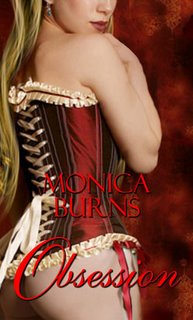
Today on Make-Believe Mondays allow me to introduce my friend Monica Burns. We met through RWA online and Monica sold me my first ebook last year at the RT convention, opening up a whole world and way of reading for me. Monica writes sensual historical romance and though she began her publishing career in ebooks, her award winning work has now found its way into the bookstores.
Is there a point when your characters begin to come alive and you can see and hear them?
Monica: Sometimes. It depends on the book. Some of my characters are more open than others. Devlyn from Love’s Revenge (in the Forbidden Pleasures anthology) has been the most outspoken of all my heroes. Probably because he’s an in-your-face alpha. He doesn’t care what people think about him. Morgan from Love’s Portrait was a bit more reserved, but he too showed up to speak his mind just the other day. I was reviewing sample bookmarks from my vendor, and they were so totally unhappy with the design they were growling like two bears. Usually, the characters don’t show to comment on my marketing items, but these two guys were unbelievable. One of them growled that he wasn’t a zebra (there were white swirls on black for the first design). Then Morgan complained about the color background and how it was too reddish brown. These two hammered away at me and my vendor until I opened up the final sample and it was like having a freaking orgasm. The guys were shouting with lots of gusto and I was drooling. So yes, my characters do come alive, and they stay with me. There’s no one certain point in time that it happens. At least not that I can tell. It’s sort of like a one day they’re not there and then the next day, poof! There they are.
Oh, I simply love this. Characters do care what happens to them, yet I'd never considered they might be concerned with their own marketing. How interesting.
For some writers, dreams play a role in creating fiction. Has this been true for you? Have you ever dreamed a scene or an image that later wound up in one of your books?
Monica: Most of my stories are from my dreams. In truth, I believe I’m seeing scenes from past lives I’ve lived or that I’m tapping into the thoughts of others in the universe when I dream. I’m very lucky that I remember most of my dreams. Not everyone has that. I still remember a dream I had when I was about 14 or 15. It ran for two nights straight, took place in the late 1800s on a train with a villain shooting the hero. Really potent stuff. *grin* I still haven’t written that dream yet, but I’m betting it’s coming.
How wonderful to remember your dreams. They can be such slippery wisps at times.
As a child did any particular book or author pull you into their imaginary world?
Monica: Well, I was a pretty unique kid. Not many 12-year-olds read Edgar Cayce for pleasure reading. LOL But I did read a lot of the classics, thanks to my wonderful maternal grandmother. The woman gave us books for presents and they were all the great classics. She’s the one who got me hooked on the Scarlet Pimpernel and the Three Musketeers. Great romantic adventures.
She sounds like an absolutely wonderful Grandmother! We should raise our glasses to the Grandmothers of the world who encourage stories and imagination!
Is there anything else you would like to add about the role of imagination, and dreams in creating fiction? Any other message for our readers?
Monica: Dream it, believe it, achieve it. That’s one of my mottos. It means that whatever I imagine, as long as I believe in it, I can achieve it. There are no limits. The universe might be shrinking in on itself, but the final collapse is so far away as to be almost infinite, so holding back is of no value to anyone, especially ones self. Imagine yourself a bird flying over a couple walking along a beach. Imagine what they’re saying to each other. Imagine what will happen when drop your load on them. LOL Just imagine it, and you’ll do it.
Monica, that is such a lovely motto and one to post by our computers as we write. Thank you for joining us here to share a little bit of the magic of writing with our readers. To learn more visit www.monicaburns.com
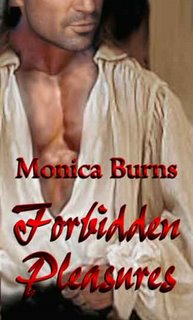

Is there a point when your characters begin to come alive and you can see and hear them?
Monica: Sometimes. It depends on the book. Some of my characters are more open than others. Devlyn from Love’s Revenge (in the Forbidden Pleasures anthology) has been the most outspoken of all my heroes. Probably because he’s an in-your-face alpha. He doesn’t care what people think about him. Morgan from Love’s Portrait was a bit more reserved, but he too showed up to speak his mind just the other day. I was reviewing sample bookmarks from my vendor, and they were so totally unhappy with the design they were growling like two bears. Usually, the characters don’t show to comment on my marketing items, but these two guys were unbelievable. One of them growled that he wasn’t a zebra (there were white swirls on black for the first design). Then Morgan complained about the color background and how it was too reddish brown. These two hammered away at me and my vendor until I opened up the final sample and it was like having a freaking orgasm. The guys were shouting with lots of gusto and I was drooling. So yes, my characters do come alive, and they stay with me. There’s no one certain point in time that it happens. At least not that I can tell. It’s sort of like a one day they’re not there and then the next day, poof! There they are.
Oh, I simply love this. Characters do care what happens to them, yet I'd never considered they might be concerned with their own marketing. How interesting.
For some writers, dreams play a role in creating fiction. Has this been true for you? Have you ever dreamed a scene or an image that later wound up in one of your books?
Monica: Most of my stories are from my dreams. In truth, I believe I’m seeing scenes from past lives I’ve lived or that I’m tapping into the thoughts of others in the universe when I dream. I’m very lucky that I remember most of my dreams. Not everyone has that. I still remember a dream I had when I was about 14 or 15. It ran for two nights straight, took place in the late 1800s on a train with a villain shooting the hero. Really potent stuff. *grin* I still haven’t written that dream yet, but I’m betting it’s coming.
How wonderful to remember your dreams. They can be such slippery wisps at times.
As a child did any particular book or author pull you into their imaginary world?
Monica: Well, I was a pretty unique kid. Not many 12-year-olds read Edgar Cayce for pleasure reading. LOL But I did read a lot of the classics, thanks to my wonderful maternal grandmother. The woman gave us books for presents and they were all the great classics. She’s the one who got me hooked on the Scarlet Pimpernel and the Three Musketeers. Great romantic adventures.
She sounds like an absolutely wonderful Grandmother! We should raise our glasses to the Grandmothers of the world who encourage stories and imagination!
Is there anything else you would like to add about the role of imagination, and dreams in creating fiction? Any other message for our readers?
Monica: Dream it, believe it, achieve it. That’s one of my mottos. It means that whatever I imagine, as long as I believe in it, I can achieve it. There are no limits. The universe might be shrinking in on itself, but the final collapse is so far away as to be almost infinite, so holding back is of no value to anyone, especially ones self. Imagine yourself a bird flying over a couple walking along a beach. Imagine what they’re saying to each other. Imagine what will happen when drop your load on them. LOL Just imagine it, and you’ll do it.
Monica, that is such a lovely motto and one to post by our computers as we write. Thank you for joining us here to share a little bit of the magic of writing with our readers. To learn more visit www.monicaburns.com

Monday, February 20, 2006
Make-Believe Mondays With Bobbi Smith
On this Make-believe Monday I'm happy to introduce New York Times best selling author Bobbi Smith. Bobbi writes western historical romance for Dorchester Publishing and she also writes inspirational romance under the name Julie Marshall.
I owe a great debt of thanks to Bobbi. Last year I entered her creative writing challenge and was thrilled to learn at the RT convention that I was a finalist. Bobbi met with each of us to advise us on our writing. She told me I needed to change one thing. My first chapter began in the wrong place. I came home, rewrote it, and entered it in the American Title II contest where it finalled again! I can honestly say that I wouldn't be where I am today without Bobbi. Thank you, Bobbi for taking the time to share so generously with authors who are just starting out.
Bobbi, first, tell us a little bit about the manuscript you’re working on now.
Bobbi: Currently, I'm starting my next historical titled Hired Gun. The heroine's sister has been taken captive by Indians and she hires our hero to track her down when all else fails. She also insists on going with him. This is going to be fun.
It does sound like fun! I'll be waiting for this one to come out!
Mark Twain said, “You cannot depend on your eyes when your imagination is out of focus.” How do you fill your creative well to keep your imagination in focus?
Bobbi: I've never thought of my imagination as being in or out of focus. My brain just takes off and all these people start talking in my head and arguing with me sometimes. Writers are weird, there's no doubt about it.
Is there a point when your characters begin to come alive and you can see and hear them?
Bobbi: By page 50 my characters are usually alive and well. It's fun when they start talking to me - especially when they come up with an idea out of
nowhere. That's amazing to me.
Some very famous authors have played with language, creating words for people or places that no one has ever heard of. Have you ever played with words in that way and if so how?
Elle: I don't play with the English language. My 7th and 8th grade teachers would be outraged! The humiliation at the blackboard back then was quite an incentive to learn how to do it right.
For some writers, dreams play a role in creating fiction. Has this been true for you? Have you ever dreamed a scene or an image that later wound up in one of your books?
Elle: I wish I could remember my dreams, but I don't. They slip away as soon as I wake up, darn it.
As a child did any particular book or author pull you into their imaginary world?
Elle: I loved Boxcar Children! It was awesome.
If there were no categories for books, no reader expectations to meet, and you could create the wildest work of imagination that you could think of what kind of story would that be?
Elle: I would like to inspire people to be kind to one another and to love one another. If my writing could achieve that, I would know that I'd used my talent in the right way.
Bobbi, you are an inspiration to us by your actions as well as the pages you've written.
Is there anything else you would like to add about the role of imagination, and dreams in creating fiction? Any other message for our readers?
Bobbi: The ability to be a storyteller is a definite gift. Writers are born, they're not made. Our imaginations are really amazing. How the brain works that way I have no idea, but I sure do have fun with it!
Bobbi, thank you for joining us here on this Make-believe Monday to share a little bit of the magic of writing with our readers.
You can learn more about Bobbi at www.bobbismithbooks.com
(Next week I will be in Tahiti with my husband celebrating our 25th wedding anniversary, so there will be no posts here until we return on March 6th. Make-believe Mondays will resume then.)
I owe a great debt of thanks to Bobbi. Last year I entered her creative writing challenge and was thrilled to learn at the RT convention that I was a finalist. Bobbi met with each of us to advise us on our writing. She told me I needed to change one thing. My first chapter began in the wrong place. I came home, rewrote it, and entered it in the American Title II contest where it finalled again! I can honestly say that I wouldn't be where I am today without Bobbi. Thank you, Bobbi for taking the time to share so generously with authors who are just starting out.
Bobbi, first, tell us a little bit about the manuscript you’re working on now.
Bobbi: Currently, I'm starting my next historical titled Hired Gun. The heroine's sister has been taken captive by Indians and she hires our hero to track her down when all else fails. She also insists on going with him. This is going to be fun.
It does sound like fun! I'll be waiting for this one to come out!
Mark Twain said, “You cannot depend on your eyes when your imagination is out of focus.” How do you fill your creative well to keep your imagination in focus?
Bobbi: I've never thought of my imagination as being in or out of focus. My brain just takes off and all these people start talking in my head and arguing with me sometimes. Writers are weird, there's no doubt about it.
Is there a point when your characters begin to come alive and you can see and hear them?
Bobbi: By page 50 my characters are usually alive and well. It's fun when they start talking to me - especially when they come up with an idea out of
nowhere. That's amazing to me.
Some very famous authors have played with language, creating words for people or places that no one has ever heard of. Have you ever played with words in that way and if so how?
Elle: I don't play with the English language. My 7th and 8th grade teachers would be outraged! The humiliation at the blackboard back then was quite an incentive to learn how to do it right.
For some writers, dreams play a role in creating fiction. Has this been true for you? Have you ever dreamed a scene or an image that later wound up in one of your books?
Elle: I wish I could remember my dreams, but I don't. They slip away as soon as I wake up, darn it.
As a child did any particular book or author pull you into their imaginary world?
Elle: I loved Boxcar Children! It was awesome.
If there were no categories for books, no reader expectations to meet, and you could create the wildest work of imagination that you could think of what kind of story would that be?
Elle: I would like to inspire people to be kind to one another and to love one another. If my writing could achieve that, I would know that I'd used my talent in the right way.
Bobbi, you are an inspiration to us by your actions as well as the pages you've written.
Is there anything else you would like to add about the role of imagination, and dreams in creating fiction? Any other message for our readers?
Bobbi: The ability to be a storyteller is a definite gift. Writers are born, they're not made. Our imaginations are really amazing. How the brain works that way I have no idea, but I sure do have fun with it!
Bobbi, thank you for joining us here on this Make-believe Monday to share a little bit of the magic of writing with our readers.
You can learn more about Bobbi at www.bobbismithbooks.com
(Next week I will be in Tahiti with my husband celebrating our 25th wedding anniversary, so there will be no posts here until we return on March 6th. Make-believe Mondays will resume then.)
Monday, February 13, 2006
Make-Believe Mondays With Elle James
This morning on Make-believe Mondays I'd like to introduce you to Elle James. I met Elle through my friend Susan and we had a blast at the RT convention last year. Elle and I are kindred spirits in that we both love to dance. Elle won the Golden Heart for paranormal romance in 2004 with To Kiss A Frog and sold it to Dorchester, launching her career. Since then she has sold to Harlequin Intrigue and has several books coming out.
Elle, first, tell us a little bit about the manuscript you’re working on now.
Elle: I’m working LAKOTA BABY for Harlequin Intrigue. It’s set on a fictitious Lakota Indian reservation in South Dakota and is about a woman who’s baby is stolen and held for ransom and how she and his father find him. I’ve finished the rough draft and hope to complete revisions by the end of February!
A stolen baby! Now that's intriguing.
Mark Twain said, “You cannot depend on your eyes when your imagination is out of focus.” How do you fill your creative well to keep your imagination in focus?
Elle: I get with my sister and my other writer friends online or in person to brainstorm and just talk about writing. There’s nothing more uplifting to an author than to talk about writing with others who “understand”.
Is there a point when your characters begin to come alive and you can see and hear them?
Elle: That point is when I put my fingers on the keyboard. I don’t have conversations in my head between them until I apply myself to actually writing the story. Then it gets fun!
Some very famous authors have played with language, creating words for people or places that no one has ever heard of. Have you ever played with words in that way and if so how?
Elle: I wrote a futuristic romance where my heroine was from another planet. I made up a curse word for her to use and you knew it was a curse word based on how she used it. Nothing too hard to pronounce, though or you lose your reader!
For some writers, dreams play a role in creating fiction. Has this been true for you? Have you ever dreamed a scene or an image that later wound up in one of your books?
Elle: No. I’m one of those “force it out” authors. I have to concentrate completely on my story ideas before they come to me. No music, no distractions, just story.
As a child did any particular book or author pull you into their imaginary world?
Elle: Wrinkle In Time and anything by Dr. Suess! I used to read short science fiction books as well about mutant people. I loved to escape into other worlds.
If there were no categories for books, no reader expectations to meet, and you could create the wildest work of imagination that you could think of what kind of story would that be?
Elle: I like what I’m writing now. I would like to do more romantic comedies because I have such fun with quirky characters and impossible situations. And I love paranormal and want to do more in that genre as well.
I'm glad to hear that, because I very much enjoyed reading To Kiss A Frog.
Is there anything else you would like to add about the role of imagination, and dreams in creating fiction? Any other message for our readers?
Elle: Not everyone has ideas popping out of their heads at all crazy hours of the morning and night, and that’s not a bad thing. I used to think, I’ll never be able to come up with a continuous stream of ideas, but I was soooo wrong. I have enough book ideas to keep me writing for the next 300 years. It’s like a muscle. Once you start make stuff up, it’s hard to quit!
Watch for my Harlequin Intrigues coming out this year!
BENEATH THE TEXAS MOON in March 2006 – paranormal and RT TOP PICK for Mar
DAKOTA MELTDOWN – Aug 2006
LAKOTA BABY – Dec 2006
You can learn more at www.ellejames.com. Elle, thanks for visiting with us here on Make-believe Mondays!
Elle, first, tell us a little bit about the manuscript you’re working on now.
Elle: I’m working LAKOTA BABY for Harlequin Intrigue. It’s set on a fictitious Lakota Indian reservation in South Dakota and is about a woman who’s baby is stolen and held for ransom and how she and his father find him. I’ve finished the rough draft and hope to complete revisions by the end of February!
A stolen baby! Now that's intriguing.
Mark Twain said, “You cannot depend on your eyes when your imagination is out of focus.” How do you fill your creative well to keep your imagination in focus?
Elle: I get with my sister and my other writer friends online or in person to brainstorm and just talk about writing. There’s nothing more uplifting to an author than to talk about writing with others who “understand”.
Is there a point when your characters begin to come alive and you can see and hear them?
Elle: That point is when I put my fingers on the keyboard. I don’t have conversations in my head between them until I apply myself to actually writing the story. Then it gets fun!
Some very famous authors have played with language, creating words for people or places that no one has ever heard of. Have you ever played with words in that way and if so how?
Elle: I wrote a futuristic romance where my heroine was from another planet. I made up a curse word for her to use and you knew it was a curse word based on how she used it. Nothing too hard to pronounce, though or you lose your reader!
For some writers, dreams play a role in creating fiction. Has this been true for you? Have you ever dreamed a scene or an image that later wound up in one of your books?
Elle: No. I’m one of those “force it out” authors. I have to concentrate completely on my story ideas before they come to me. No music, no distractions, just story.
As a child did any particular book or author pull you into their imaginary world?
Elle: Wrinkle In Time and anything by Dr. Suess! I used to read short science fiction books as well about mutant people. I loved to escape into other worlds.
If there were no categories for books, no reader expectations to meet, and you could create the wildest work of imagination that you could think of what kind of story would that be?
Elle: I like what I’m writing now. I would like to do more romantic comedies because I have such fun with quirky characters and impossible situations. And I love paranormal and want to do more in that genre as well.
I'm glad to hear that, because I very much enjoyed reading To Kiss A Frog.
Is there anything else you would like to add about the role of imagination, and dreams in creating fiction? Any other message for our readers?
Elle: Not everyone has ideas popping out of their heads at all crazy hours of the morning and night, and that’s not a bad thing. I used to think, I’ll never be able to come up with a continuous stream of ideas, but I was soooo wrong. I have enough book ideas to keep me writing for the next 300 years. It’s like a muscle. Once you start make stuff up, it’s hard to quit!
Watch for my Harlequin Intrigues coming out this year!
BENEATH THE TEXAS MOON in March 2006 – paranormal and RT TOP PICK for Mar
DAKOTA MELTDOWN – Aug 2006
LAKOTA BABY – Dec 2006
You can learn more at www.ellejames.com. Elle, thanks for visiting with us here on Make-believe Mondays!
Monday, February 06, 2006
Make-Believe Mondays With Laura Drewry
So many of you have written to me expressing how much you enjoy reading western historical romances. I'm happy to introduce Laura Drewry, one of my friends from RWAonline on this Make-believe Monday. Laura's first book, Here Comes the Bride was published by Kensington in 2005. If you like reading western historical romance, you'll enjoy this one.
Laura, tell us a little bit about the manuscript you're working on now.
Laura: I have a new book, CHARMING JO, coming out in September. In the meantime, I'm working on a proposal for a western historical trilogy that's been a lot of fun to create. I'm very superstitious about jinxing myself (don't laugh at me! LOL), so I don't want to get into too much detail about it, but let me just say this - all hell breaks loose in these books. After this, I have a couple contemporary stories I'd like to work on. That will take me a lot of practice, though, because I find them so much harder to write.
Laura, I certainly would never laugh at that. There's a bit of magic and mystery to creating a story and to be honest, I don't like to talk abut my stories until that first draft is done.
Mark Twain said, "You cannot depend on your eyes when your imagination is out of focus." How do you fill your creative well to keep your imagination in focus?
Laura: I read, I try to take in as much as I can when I'm outside or even in the mall, and I listen to what people are saying. I find that because the world is so busy, we can tend to get caught up in our little worlds and forget that there's so much more out there. So what I've started doing is studying the people I see (not my friends, but strangers who are driving or walking by). Who are they? Where are they from? Where are they going? Why? What joys and tragedies have they lived through? I don't know that this actually keeps my imagination in focus, but it sure keeps it busy!
Is there a point when your characters begin to come alive and you can see and hear them?
Laura: My characters take over right from the get-go. I do my best to try and rein them in, but it never works. They always take over and run the story in directions I would never anticipate. They say things that shock me, and I'm the one typing the story! I don't know how it happens, and I'm sure anyone who doesn't write probably thinks I'm completely off my nut, but that's how my stories get written.
Some very famous authors have played with language, creating words for people or places that no one has ever heard of. Have you ever played with words in that way and if so how?
Laura: No, not so much. Though I will admit to 'borrowing' certain words and expressions from my family. One of my favorites is my Grandma's expression 'gawkarse'. When I introduced Bart as the brother in HERE COMES THE BRIDE, I knew it was an expression he'd have to use.
As a child did any particular book or author pull you into their imaginary world?
Laura: The first book I ever remember owning was On The Banks of Plum Creek by Laura Ingalls Wilder. I was probably 6 or 7 when I won it at a neighbors birthday party and it immediately sucked me in. Made my parents' life easy, though, because for the next several years they had easy gifts for me for Christmas and my birthday. I've kept the whole series, too. Love them all.
If there were no categories for books, no reader expectations to meet, and you could create the wildest work of imagination that you could think of what kind of story would that be?
Laura: Honestly - it would be a romance. I'm far from perfect, but I do believe if we'd all just let ourselves love each other, the world would be a much
better place. And I think that's what we get from a romance novel. It shows us that love can build bridges, it can climb mountains and it can do everything all the other cliches say it can. We just have to believe in it.
Is there anything else you would like to add about the role of imagination, and dreams in creating fiction? Any other message for our readers?
Laura: Your imagination needs to be exercised. If you dream a scene and are able to get it down before you forget it, more the better. But in between those dreams, you need to stretch your imagination. You need to slough off the restraints of being an adult and put your mind back to when you were a child and everything was exciting; everything had possibilities. Every idea has the opportunity of being a great story - it just needs someone to tell it. If you've imagined an idea or a scene and it's not working for you right now - save it. Jot it down and file it away. It might not work in the story you're writing now and it may never see the light of day. But you never know what other ideas will spin off that one when you re-read it a year from now.
You're right. Children don't put limits on themselves the way we do as adults. Ideas are out there waiting to be caught like fireflies.
Laura, thank you for joining us here on this Make-believe Monday to share a glimpse into the creative world we authors live in.
Thank you, Debra, for including me!
Visit Laura's website at www.lauradrewry.com
Laura, tell us a little bit about the manuscript you're working on now.
Laura: I have a new book, CHARMING JO, coming out in September. In the meantime, I'm working on a proposal for a western historical trilogy that's been a lot of fun to create. I'm very superstitious about jinxing myself (don't laugh at me! LOL), so I don't want to get into too much detail about it, but let me just say this - all hell breaks loose in these books. After this, I have a couple contemporary stories I'd like to work on. That will take me a lot of practice, though, because I find them so much harder to write.
Laura, I certainly would never laugh at that. There's a bit of magic and mystery to creating a story and to be honest, I don't like to talk abut my stories until that first draft is done.
Mark Twain said, "You cannot depend on your eyes when your imagination is out of focus." How do you fill your creative well to keep your imagination in focus?
Laura: I read, I try to take in as much as I can when I'm outside or even in the mall, and I listen to what people are saying. I find that because the world is so busy, we can tend to get caught up in our little worlds and forget that there's so much more out there. So what I've started doing is studying the people I see (not my friends, but strangers who are driving or walking by). Who are they? Where are they from? Where are they going? Why? What joys and tragedies have they lived through? I don't know that this actually keeps my imagination in focus, but it sure keeps it busy!
Is there a point when your characters begin to come alive and you can see and hear them?
Laura: My characters take over right from the get-go. I do my best to try and rein them in, but it never works. They always take over and run the story in directions I would never anticipate. They say things that shock me, and I'm the one typing the story! I don't know how it happens, and I'm sure anyone who doesn't write probably thinks I'm completely off my nut, but that's how my stories get written.
Some very famous authors have played with language, creating words for people or places that no one has ever heard of. Have you ever played with words in that way and if so how?
Laura: No, not so much. Though I will admit to 'borrowing' certain words and expressions from my family. One of my favorites is my Grandma's expression 'gawkarse'. When I introduced Bart as the brother in HERE COMES THE BRIDE, I knew it was an expression he'd have to use.
As a child did any particular book or author pull you into their imaginary world?
Laura: The first book I ever remember owning was On The Banks of Plum Creek by Laura Ingalls Wilder. I was probably 6 or 7 when I won it at a neighbors birthday party and it immediately sucked me in. Made my parents' life easy, though, because for the next several years they had easy gifts for me for Christmas and my birthday. I've kept the whole series, too. Love them all.
If there were no categories for books, no reader expectations to meet, and you could create the wildest work of imagination that you could think of what kind of story would that be?
Laura: Honestly - it would be a romance. I'm far from perfect, but I do believe if we'd all just let ourselves love each other, the world would be a much
better place. And I think that's what we get from a romance novel. It shows us that love can build bridges, it can climb mountains and it can do everything all the other cliches say it can. We just have to believe in it.
Is there anything else you would like to add about the role of imagination, and dreams in creating fiction? Any other message for our readers?
Laura: Your imagination needs to be exercised. If you dream a scene and are able to get it down before you forget it, more the better. But in between those dreams, you need to stretch your imagination. You need to slough off the restraints of being an adult and put your mind back to when you were a child and everything was exciting; everything had possibilities. Every idea has the opportunity of being a great story - it just needs someone to tell it. If you've imagined an idea or a scene and it's not working for you right now - save it. Jot it down and file it away. It might not work in the story you're writing now and it may never see the light of day. But you never know what other ideas will spin off that one when you re-read it a year from now.
You're right. Children don't put limits on themselves the way we do as adults. Ideas are out there waiting to be caught like fireflies.
Laura, thank you for joining us here on this Make-believe Monday to share a glimpse into the creative world we authors live in.
Thank you, Debra, for including me!
Visit Laura's website at www.lauradrewry.com
Monday, January 30, 2006
Make-Believe Mondays With Cie Adams
On this Make-believe Monday I'd like to introduce Cie Adams, one of my friends from RWAonline. Cie pairs up with Cathy Clamp to write paranormal romance for TOR. Their first book, Hunters Moon, is winning awards and they have contracted for several more books.
Cie, first, tell us a little bit about the manuscript you’re working on now.
Cie: It's a paranormal, but a little "lighter" than my usual stuff. I think I got so tired after the last book that my subconscious decided I needed a break. (LOL) The world is very much our current world, where very few people believe in magic and Fairie. But it does exist. This book will have a very kick-butt heroine who is half human and half-Sidhe who stumbles into a very nasty plot that she and the hero work together to foil. I'm having an awful lot of fun with it!
Mark Twain said, “You cannot depend on your eyes when your imagination is out of focus.” How do you fill your creative well to keep your imagination in focus?
Cie: My main problem is that I have some ongoing health issues, so I have to be very sure not to get too stressed, to eat well, exercise, and sleep. All those "boring" things add up and really make a difference. Because if I'm not well, I'm not able to think clearly, let alone creatively.
Is there a point when your characters begin to come alive and you can see and hear them?
Cie: Generally they fall into my head fully formed. I know it's weird, but to me they are "people" and I just happen to be looking in on what's happening to them at a given point. The plot can be nebulous, but the people are who they are – and I can't change them any more than I can change the people at work or the grocery store in my real life.
Some very famous authors have played with language, creating words for people or places that no one has ever heard of. Have you ever played with words in that way and if so how?
Cie: Once upon a time, when I was very young I created an entire alphabet and was working on a language. I've also created worlds when I've written fantasy or entire cultures for the paranormals. That's one of the things I love best about writing. I get to play pretend and get paid for it!
For some writers, dreams play a role in creating fiction. Has this been true for you? Have you ever dreamed a scene or an image that later wound up in one of your books?
Cie: I have for short stories, but not the books. Honestly, I'm not sure where the books come from. The imagination just creates them out of thin air as far as I can tell.
As a child did any particular book or author pull you into their imaginary world?
Cie: It's funny, as a child I moved into adult books right away. It was only when I got older (late adolescence and adulthood) that I re-discovered children books. I remember loving "A Wrinkle in Time" all the "Borrower" books and "Jennifer, Hecate, Macbeth, William McKinley, and Me, Elizabeth" and so many more.
If there were no categories for books, no reader expectations to meet, and you could create the wildest work of imagination that you could think of what kind of story would that be?
Cie: Ironically, not much different than what I currently write. I've been very lucky in that I apparently have very mainstream tastes. (LOL)
Is there anything else you would like to add about the role of imagination, and dreams in creating fiction? Any other message for our readers?
Cie: Wow. Well, I don't know if this counts, but(Quoting Freud) – "Sometimes a cigar is just a cigar." A lot of people assume that if a character you write has certain attitudes, so do you, or if they come from a troubled background, you do too. Not so. As I told my Mom – "Happy backgrounds tend to read kind of boring. Characters need conflict." It takes all kinds of characters to create a believable world and believable conflict – which means that some of them are bound to have characteristics that don't reflect the writer's beliefs at all. So don't hold me to blame for my character the serial killer!
Cie, thanks for joining us here on Make-believe Mondays to give us a glimpse into the creative life. I can't wait to see how you combine the "real world" with faerie creatures.
Visit Cie's website at www.ciecatrunpubs.com to learn more.
Cie, first, tell us a little bit about the manuscript you’re working on now.
Cie: It's a paranormal, but a little "lighter" than my usual stuff. I think I got so tired after the last book that my subconscious decided I needed a break. (LOL) The world is very much our current world, where very few people believe in magic and Fairie. But it does exist. This book will have a very kick-butt heroine who is half human and half-Sidhe who stumbles into a very nasty plot that she and the hero work together to foil. I'm having an awful lot of fun with it!
Mark Twain said, “You cannot depend on your eyes when your imagination is out of focus.” How do you fill your creative well to keep your imagination in focus?
Cie: My main problem is that I have some ongoing health issues, so I have to be very sure not to get too stressed, to eat well, exercise, and sleep. All those "boring" things add up and really make a difference. Because if I'm not well, I'm not able to think clearly, let alone creatively.
Is there a point when your characters begin to come alive and you can see and hear them?
Cie: Generally they fall into my head fully formed. I know it's weird, but to me they are "people" and I just happen to be looking in on what's happening to them at a given point. The plot can be nebulous, but the people are who they are – and I can't change them any more than I can change the people at work or the grocery store in my real life.
Some very famous authors have played with language, creating words for people or places that no one has ever heard of. Have you ever played with words in that way and if so how?
Cie: Once upon a time, when I was very young I created an entire alphabet and was working on a language. I've also created worlds when I've written fantasy or entire cultures for the paranormals. That's one of the things I love best about writing. I get to play pretend and get paid for it!
For some writers, dreams play a role in creating fiction. Has this been true for you? Have you ever dreamed a scene or an image that later wound up in one of your books?
Cie: I have for short stories, but not the books. Honestly, I'm not sure where the books come from. The imagination just creates them out of thin air as far as I can tell.
As a child did any particular book or author pull you into their imaginary world?
Cie: It's funny, as a child I moved into adult books right away. It was only when I got older (late adolescence and adulthood) that I re-discovered children books. I remember loving "A Wrinkle in Time" all the "Borrower" books and "Jennifer, Hecate, Macbeth, William McKinley, and Me, Elizabeth" and so many more.
If there were no categories for books, no reader expectations to meet, and you could create the wildest work of imagination that you could think of what kind of story would that be?
Cie: Ironically, not much different than what I currently write. I've been very lucky in that I apparently have very mainstream tastes. (LOL)
Is there anything else you would like to add about the role of imagination, and dreams in creating fiction? Any other message for our readers?
Cie: Wow. Well, I don't know if this counts, but(Quoting Freud) – "Sometimes a cigar is just a cigar." A lot of people assume that if a character you write has certain attitudes, so do you, or if they come from a troubled background, you do too. Not so. As I told my Mom – "Happy backgrounds tend to read kind of boring. Characters need conflict." It takes all kinds of characters to create a believable world and believable conflict – which means that some of them are bound to have characteristics that don't reflect the writer's beliefs at all. So don't hold me to blame for my character the serial killer!
Cie, thanks for joining us here on Make-believe Mondays to give us a glimpse into the creative life. I can't wait to see how you combine the "real world" with faerie creatures.
Visit Cie's website at www.ciecatrunpubs.com to learn more.
Monday, January 16, 2006
Make Believe Mondays With Katrina Kittle
I'm pleased to introduce my dear friend, Katrina Kittle, on this Make-believe Monday.
I met Katrina at the Antioch Writers Workshop several years ago when I was in her fiction workshop. Katrina has written two books for Warner and is now writing for William Morrow. Her latest book, The Kindness of Strangers will be in the stores on February 1st and I'll be one of the first in line to buy it. Katrina writes characters who are so real they could live right next door and her characters always touch my heart.
Katrina, first tell us a little bit about the manuscript you're working on now.
Katrina: I'm struggling to keep momentum going on the my fourth novel--currently titled My Beautiful Disaster--while I gear up for the release of my third, The Kindness of Strangers. The fourth book is still in "baby stages" and close to the end of a first draft. It's hard for me to talk about a story until I finish a first draft. It's almost as if I don't really know what it's about myself yet. But...all of my novels have started with some kind of social issue I care about, and then I try to build a story around that issue that raises--but doesn't necessarily answer--questions surrounding that issue. This book I jokingly call the "marriage book." I'm interested in the purpose of marriage. Lots of people say it has no purpose today, that the reasons for which marriage was created no longer apply. Hmm. I DO believe there's a purpose for marriage and I'm toying with articulating that. So...this book deals with marriage, flawed and successful (not that those are mutually exclusive), gay marriage, divorce, body image, eating disorders...with lots and lots of horses and a visit to Africa thrown in! That's all I can say at the moment. I'll keep you posted.
Since I've heard some of the stories of your visit to Africa, I can't wait to see how this book turns out!
Mark Twain said, "You cannot depend on your eyes when your imagination is out of focus." How do you fill your creative well to keep your imagination in focus?
Katrina: Years ago, I'm so happy I discovered Julia Cameron's fabulous book, The Artist's Way. She talks about "artist dates" and how we need to take our artist selves out to play for this very purpose: to fill the well. It's a constant struggle--we so often scrimp on time for ourselves in order to take care of others--but I try to keep my artist dates. The idea is that you go out to play in some way, whatever your heart desires. You don't need to justify it or rationalize it, and it should never, never be some virtuous thing you feel you "should" do. I keep a list of things I'd like to do, and I keep my eye out for those odd little happenings in the paper. I've danced to show tunes, gone to a class on coyotes in the Ohio area, hiked in the woods, wandered through greenhouses, strolled around in cemeteries, gone by myself to interesting little coffee houses to read poetry books or trashy magazines (sorry Lucy!) I bought on a whim, watched a draft horse pulling competition, went to the opening of a Peace Museum, colored in a coloring book, made a collage out of magazine pictures. The idea of experiencing the new is important. There's a quote (I don't remember who said it) that goes: "Each time you experience the new you become open to inspiration."
How right you are about taking care of others and the need to take care of the inner artist. I especially like the way you stay open to the unplanned adventure, to the new. Inspiration is just waiting around the next corner, isn't it?
As a child did any particular book or author pull you into their imaginary world?
Katrina: I was a a voracious reader. LOTS of books pulled me into their worlds, and I'm so, so grateful. I absolutely adored the Nancy Drew series. She was smart and strong and could do EVERYTHING (it's really kind of ridiculous, all the bizarre talents she had--she could speak a bazillion languages, do ballet, ride horseback, do circus stunts on horseback, had skill in archery, row, run, do gymnastics, play tennis, swim, perform any kind of medical service needed...the list was endless...). I loved her competence! And she was always cool and the epitome of grace under pressure. I would pretend to be her and would play for hours this way. But I was a huge lover of anything with ghosts or the supernatural or magical in them. Anything where animals and humans could talk to each other was right up my alley!
Katrina, thank you for joining us here on this Make-belive Monday to share a little bit of the magic of writing with our readers. May your days be full of new and unexpected adventures and your creative well always be full.
Visist Katrina's website at http:www.katrinakittle.com and look for her new book on Feb. 1st!
I met Katrina at the Antioch Writers Workshop several years ago when I was in her fiction workshop. Katrina has written two books for Warner and is now writing for William Morrow. Her latest book, The Kindness of Strangers will be in the stores on February 1st and I'll be one of the first in line to buy it. Katrina writes characters who are so real they could live right next door and her characters always touch my heart.
Katrina, first tell us a little bit about the manuscript you're working on now.
Katrina: I'm struggling to keep momentum going on the my fourth novel--currently titled My Beautiful Disaster--while I gear up for the release of my third, The Kindness of Strangers. The fourth book is still in "baby stages" and close to the end of a first draft. It's hard for me to talk about a story until I finish a first draft. It's almost as if I don't really know what it's about myself yet. But...all of my novels have started with some kind of social issue I care about, and then I try to build a story around that issue that raises--but doesn't necessarily answer--questions surrounding that issue. This book I jokingly call the "marriage book." I'm interested in the purpose of marriage. Lots of people say it has no purpose today, that the reasons for which marriage was created no longer apply. Hmm. I DO believe there's a purpose for marriage and I'm toying with articulating that. So...this book deals with marriage, flawed and successful (not that those are mutually exclusive), gay marriage, divorce, body image, eating disorders...with lots and lots of horses and a visit to Africa thrown in! That's all I can say at the moment. I'll keep you posted.
Since I've heard some of the stories of your visit to Africa, I can't wait to see how this book turns out!
Mark Twain said, "You cannot depend on your eyes when your imagination is out of focus." How do you fill your creative well to keep your imagination in focus?
Katrina: Years ago, I'm so happy I discovered Julia Cameron's fabulous book, The Artist's Way. She talks about "artist dates" and how we need to take our artist selves out to play for this very purpose: to fill the well. It's a constant struggle--we so often scrimp on time for ourselves in order to take care of others--but I try to keep my artist dates. The idea is that you go out to play in some way, whatever your heart desires. You don't need to justify it or rationalize it, and it should never, never be some virtuous thing you feel you "should" do. I keep a list of things I'd like to do, and I keep my eye out for those odd little happenings in the paper. I've danced to show tunes, gone to a class on coyotes in the Ohio area, hiked in the woods, wandered through greenhouses, strolled around in cemeteries, gone by myself to interesting little coffee houses to read poetry books or trashy magazines (sorry Lucy!) I bought on a whim, watched a draft horse pulling competition, went to the opening of a Peace Museum, colored in a coloring book, made a collage out of magazine pictures. The idea of experiencing the new is important. There's a quote (I don't remember who said it) that goes: "Each time you experience the new you become open to inspiration."
How right you are about taking care of others and the need to take care of the inner artist. I especially like the way you stay open to the unplanned adventure, to the new. Inspiration is just waiting around the next corner, isn't it?
As a child did any particular book or author pull you into their imaginary world?
Katrina: I was a a voracious reader. LOTS of books pulled me into their worlds, and I'm so, so grateful. I absolutely adored the Nancy Drew series. She was smart and strong and could do EVERYTHING (it's really kind of ridiculous, all the bizarre talents she had--she could speak a bazillion languages, do ballet, ride horseback, do circus stunts on horseback, had skill in archery, row, run, do gymnastics, play tennis, swim, perform any kind of medical service needed...the list was endless...). I loved her competence! And she was always cool and the epitome of grace under pressure. I would pretend to be her and would play for hours this way. But I was a huge lover of anything with ghosts or the supernatural or magical in them. Anything where animals and humans could talk to each other was right up my alley!
Katrina, thank you for joining us here on this Make-belive Monday to share a little bit of the magic of writing with our readers. May your days be full of new and unexpected adventures and your creative well always be full.
Visist Katrina's website at http:www.katrinakittle.com and look for her new book on Feb. 1st!
Monday, January 09, 2006
Make-Believe Mondays With Lucy Monroe
I'm thrilled to introduce my dear friend and mentor Lucy Monroe on our first Make-believe Monday.
Lucy writes wonderful romances filled with heroic men and modern women and she writes for three publishing houses. Berkley Sensation, Harlequin Presents and Kensington Brava. On my most recent visit to her website I counted 51 books!
She truly is an amazing author, so let's find out what she has to say about creativity and imagination.
Mark Twain said, "You cannot depend on your eyes when your imagination is out of focus." How do you fill your creative well to keep your imagination in focus?
Lucy:For one thing, you can't stay creative if all you do is create. So, taking time off from creating is a must for me...just not an easy thing to do. I also love to read magazines...not gossip rags (yuck), but stuff like "The Smitsonian", "Architectural Digest" and "Harper's Bazaar", etc. I've just recently taken up knitting and a rousing game of Perquacky with my family can be very creativity enhancing. I also read tons, both fiction and nonfiction, but romance is my favorite. I re-read my favorite authors over and over again and I think that helps me write better. Learning in cockpit as they say. But it fills up my creative well to sip at someone else's.
What a lovely thought. I can just picture authors visiting each other and dipping down to gather that cool clear water before sipping. Creative works can nourish the soul that way.
Is there a point when your characters begin to come alive and you can see and hear them?
Lucy:Usually before I ever type the first word in their story, but sometimes they are nebulous beings that only become concrete after I've really settled the first 50 or so pages of their stories. They always do become concrete and very real to me at some point in the process though.
For some writers, dreams play a role in creating fiction. Has this been true for you? Have you ever dreamed a scene or an image that later wound up in one of your books?
Lucy:I get lots of story ideas from dreams and find that I dream more vividly (and remember my dreams better) when I'm not writing. So, clearly, I've got to get better about taking time off if I want more story ideas to buzz around inside my brain. My agent calls it thinking time...for me, it's dreaming time.
Lucy, thank you for joining us and sharing a glimpse into the creative life of an author. May your dreams be plentiful and your well always full.
To learn more about Lucy and the many stories she's written, visit http:www.lucymonroe.com
Lucy writes wonderful romances filled with heroic men and modern women and she writes for three publishing houses. Berkley Sensation, Harlequin Presents and Kensington Brava. On my most recent visit to her website I counted 51 books!
She truly is an amazing author, so let's find out what she has to say about creativity and imagination.
Mark Twain said, "You cannot depend on your eyes when your imagination is out of focus." How do you fill your creative well to keep your imagination in focus?
Lucy:For one thing, you can't stay creative if all you do is create. So, taking time off from creating is a must for me...just not an easy thing to do. I also love to read magazines...not gossip rags (yuck), but stuff like "The Smitsonian", "Architectural Digest" and "Harper's Bazaar", etc. I've just recently taken up knitting and a rousing game of Perquacky with my family can be very creativity enhancing. I also read tons, both fiction and nonfiction, but romance is my favorite. I re-read my favorite authors over and over again and I think that helps me write better. Learning in cockpit as they say. But it fills up my creative well to sip at someone else's.
What a lovely thought. I can just picture authors visiting each other and dipping down to gather that cool clear water before sipping. Creative works can nourish the soul that way.
Is there a point when your characters begin to come alive and you can see and hear them?
Lucy:Usually before I ever type the first word in their story, but sometimes they are nebulous beings that only become concrete after I've really settled the first 50 or so pages of their stories. They always do become concrete and very real to me at some point in the process though.
For some writers, dreams play a role in creating fiction. Has this been true for you? Have you ever dreamed a scene or an image that later wound up in one of your books?
Lucy:I get lots of story ideas from dreams and find that I dream more vividly (and remember my dreams better) when I'm not writing. So, clearly, I've got to get better about taking time off if I want more story ideas to buzz around inside my brain. My agent calls it thinking time...for me, it's dreaming time.
Lucy, thank you for joining us and sharing a glimpse into the creative life of an author. May your dreams be plentiful and your well always full.
To learn more about Lucy and the many stories she's written, visit http:www.lucymonroe.com
Subscribe to:
Comments (Atom)


 Posts
Posts

